Youth Fundraising at Scale: The Network Effect | RaffleGives
Schools, sports teams and Scouting organizations already have powerful fundraising networks. Learn how the Ambassador model can turn families, volunteers, teams and local groups into a scalable distribution engine for one central raffle campaign.
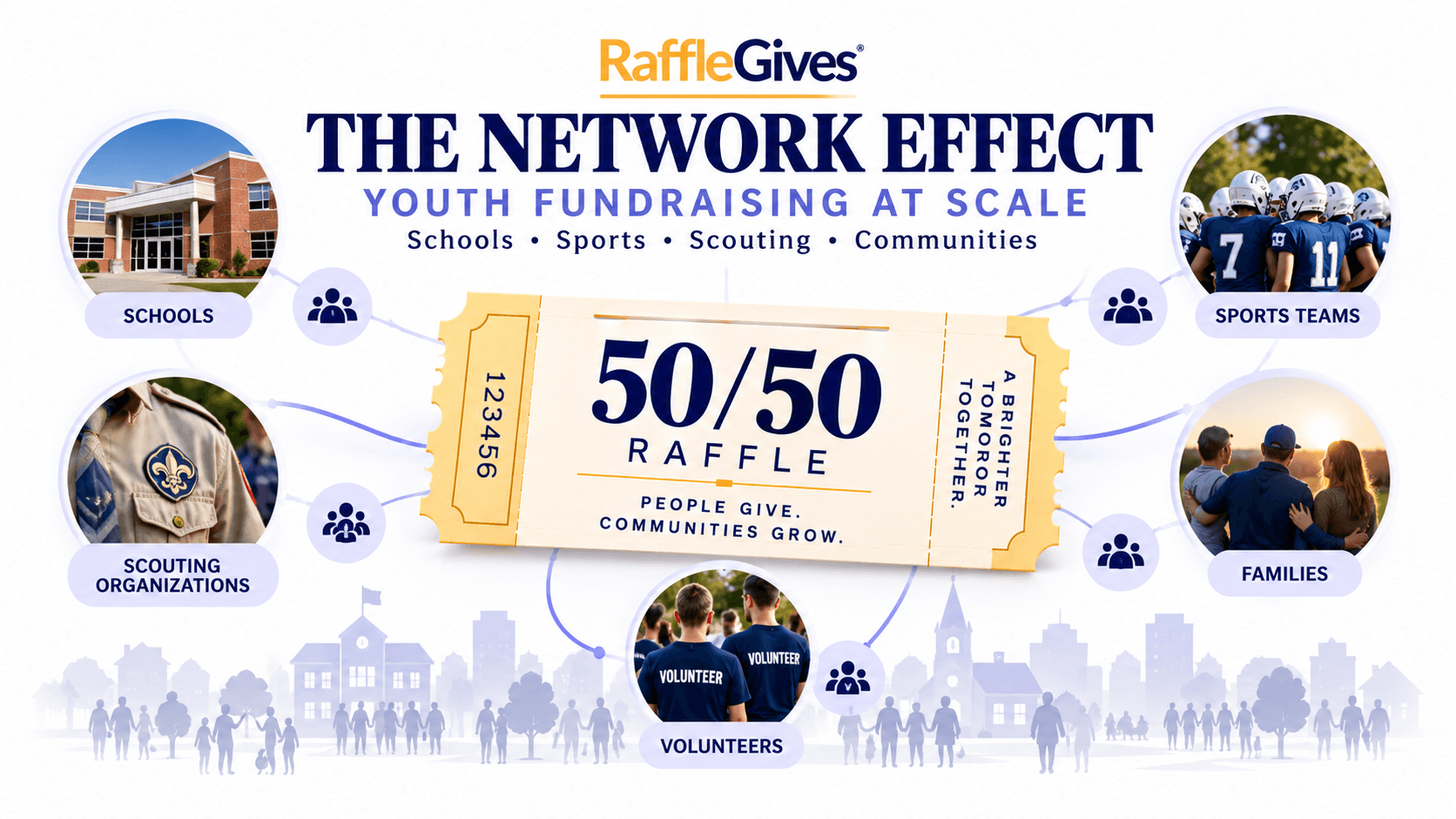
The Network Effect in Youth Fundraising: How Schools, Sports Teams and Scouting Organizations Can Scale One Raffle Across an Entire Community
Youth organizations often have a fundraising advantage hiding in plain sight. A school may have hundreds or thousands of students connected to parents, grandparents, teachers, alumni and local businesses. A youth sports organization may include dozens of teams, hundreds of athletes and an even larger community of families, coaches and supporters. Scouting organizations can extend across councils, units, volunteers, families and community partners.
Yet traditional fundraising often activates only a fraction of that network. A small committee organizes the fundraiser, the organization sends several emails, social media posts go out, and the same familiar group of supporters is asked to contribute again. The organization may have thousands of relationships surrounding it, but its fundraising remains centralized.
Digital fundraising creates an opportunity to change that model. Instead of treating families, volunteers and members only as potential donors, youth organizations can empower them to become part of the campaign's distribution network. When hundreds or thousands of people can introduce the same fundraiser to their own communities, the potential reach of a single campaign changes dramatically.
That is the network effect in youth fundraising.
Quick Answer: Why Are Youth Organizations Built to Scale Fundraising?
Youth organizations already possess one of the most valuable assets in fundraising: large networks of people connected through trusted relationships. The challenge is giving those people a simple way to participate without turning every parent, coach or volunteer into a professional fundraiser.
Instead of asking one fundraising committee to reach the entire community, an organization can activate families, teams, classrooms, volunteers, units and other groups as fundraising Ambassadors. Each Ambassador can introduce the campaign to people the central organization may never reach directly. A centralized fundraiser can therefore become a distributed fundraising network.
For organizations with hundreds or thousands of participating families, the difference can be substantial. The organization's existing membership is no longer simply the audience for the fundraiser. It becomes the infrastructure through which the fundraiser can grow.
The Difference Between Having a Large Community and Activating One
Consider a youth organization with 2,000 participating families. The organization might have all 2,000 families in its database, allowing it to send campaign announcements, newsletters and fundraising appeals directly to them. In a traditional campaign, those 2,000 households may represent most of the organization's immediately addressable fundraising audience.
But those families collectively know far more than 2,000 people. Parents have coworkers and friends. Grandparents have their own communities. Coaches have professional and personal networks, while volunteers belong to churches, businesses, civic organizations and neighborhood groups.
The organization's database therefore represents only the first layer of its potential fundraising network. The larger opportunity exists beyond it, inside the thousands of individual relationships already connected to the organization.
The challenge is finding a fundraising model capable of reaching that second layer without requiring the central organization to identify and market to every person individually.
Why Does Peer-to-Peer Fundraising Work?
The principle behind this model is already well established in nonprofit fundraising. Peer-to-peer campaigns expand an organization's reach by allowing supporters to introduce a cause to people in their own personal networks.
America's 30 largest peer-to-peer fundraising programs raised approximately $1.17 billion in 2025 while engaging 2.63 million participants, according to the Peer-to-Peer Professional Forum. Revenue increased 3.4% from the previous year while participation increased 3.6%. (Peer-to-Peer Professional Forum)
GivingTuesday has similarly highlighted how peer-to-peer fundraising allows nonprofit organizations to reach supporters through friends, relatives, colleagues and other people they already trust. (GivingTuesday) Instead of every fundraising message originating from an institution, supporters themselves help carry the campaign into new communities.
That principle maps naturally onto youth organizations because they are already built around relationships. Schools, sports teams and Scouting organizations do not need to manufacture the underlying network. They need a fundraising system capable of activating it.
Why Are Schools Naturally Built for Network Fundraising?
A school is not really one audience. It is a collection of overlapping communities that may include classrooms, grade levels, sports teams, clubs, performing arts programs, parent organizations, teachers, administrators, alumni and local partners.
Each of those groups represents another potential distribution point for a fundraising campaign. Instead of relying entirely on the PTA, booster club or development office to promote the fundraiser, participating groups can help extend the campaign into their own networks.
This changes what families are being asked to do. A traditional fundraiser may primarily ask each family to purchase something or make a donation. A network-based campaign can also ask families to help the organization reach people it cannot reach on its own.
Grandparents, relatives, coworkers, neighbors, alumni and community supporters can become part of the campaign without the school having to acquire each relationship individually. For PTAs, PTOs, booster clubs, school foundations and other eligible organizations, that creates a fundamentally different model for expanding fundraising reach.
Why Does the Same Model Work for Youth Sports?
Youth sports organizations have a similar structural advantage. A league may contain divisions, divisions contain teams, teams contain athletes, and every athlete is connected to a family with another personal and professional network surrounding it.
Fundraising can therefore move through the organization instead of being managed exclusively from the top. Rather than asking one league account to repeatedly promote the same fundraiser to the same social media followers, teams, coaches and families can help distribute the campaign into different communities.
This model can also reduce one of the recurring problems in youth sports fundraising: volunteer workload. Parents already balance practices, games, travel, work and family responsibilities. Fundraisers that require product handling, order forms, collection, event staffing or manual reconciliation create additional work for people whose time is already limited.
Digital distribution changes that workload. Families can spend more of their effort sharing the campaign and less time handling the mechanics of processing each transaction.
Scouting Organizations Demonstrate the Power of a Distributed Structure
Few youth organizations illustrate the potential of a distributed network as clearly as Scouting. Scouting America reports more than 1 million youth members and 628,000 volunteers throughout the United States and its territories. Its programs operate through local organizations and volunteer-led units supported by local councils. (Scouting America)
Its organizational resources also describe volunteers as an important part of boards, committees, units and financial operations. (Scouting America) That creates layers of existing relationships extending from the broader organization down into individual communities.
The fundraising lesson applies far beyond Scouting. As an organization becomes larger and more distributed, distributed fundraising can become more valuable because the central organization no longer has to be the only source of campaign reach. Infrastructure can be created at the organizational level while participation expands through local communities.
RaffleGives has worked with schools, youth sports groups and Scouting organizations, and we repeatedly see the same underlying opportunity. These organizations often already possess the network required to expand a fundraising campaign. The challenge is giving that network a simple and measurable way to participate.
Scouting organizations must still follow their internal fundraising requirements. Scouting America's fiscal policies state that unit fundraising requires appropriate approval from the chartered organization and local council, illustrating why internal organizational policies must be considered alongside applicable charitable gaming laws. (Scouting America)

What Is the RaffleGives Ambassador Program?
The RaffleGives online raffle platform includes an Ambassador Program designed specifically around distributed fundraising. Organizations can create unique shareable links and QR codes for Ambassadors or participating groups, allowing more people to help distribute one central campaign.
An Ambassador does not need to be a professional fundraiser. For a school, an Ambassador could represent a classroom, grade level, sports team, club or parent group. For youth sports, Ambassadors might include teams, coaches or participating families. For a larger youth organization, the structure can extend across approved chapters, locations, units or other organizational groups.
Instead of giving everyone one generic campaign URL and hoping people share it, the organization can create trackable pathways into the same campaign. That makes distributed fundraising measurable and gives the organization greater visibility into how different parts of its network are participating.
The organization retains the central campaign while the network helps distribute it.
How Does an Ambassador Raffle Work?
The organization begins with one central campaign and establishes its raffle structure, campaign period, ticket pricing and fundraising objectives according to applicable legal and organizational requirements. Once the campaign is ready, the organization can begin activating its network.
Different groups or Ambassadors receive shareable links or QR codes associated with their participation. They can distribute those links through text messages, email, social media, workplace conversations, events and the community relationships they already have.
Supporters are directed back into the same underlying raffle experience. The organization does not need hundreds of independent fundraisers operating separate systems. It can maintain one campaign while creating hundreds or potentially thousands of distribution points around it.
This is where the model begins to scale. The technology centralizes campaign administration while people decentralize campaign reach.
What Does “Hyperscaling” a Youth Fundraiser Actually Mean?
Hyperscaling a fundraiser does not mean expecting one family to sell hundreds of tickets. The more scalable approach is to increase the number of people capable of distributing the campaign while keeping the burden on each individual relatively small.
Consider a hypothetical organization with 100 local groups. If only one central office promotes the fundraiser, the organization essentially has one primary distribution engine. If all 100 groups participate, the organization suddenly has 100 potential distribution centers operating within the same campaign.
Now imagine each of those groups activates 20 families or volunteers. That creates as many as 2,000 potential Ambassadors. If those Ambassadors each introduce the campaign to just 25 people across their personal and professional relationships, the theoretical network exposure becomes 50,000 potential connections.
That is not a revenue forecast. Not every Ambassador will participate, not every contact will see the message, and not everyone who sees the campaign will purchase a ticket. The example simply illustrates the mathematics behind distributed fundraising: the opportunity comes from multiplication rather than repeatedly marketing to the same audience.
Why Can Raffles Be Particularly Well Suited to Network Fundraising?
Traditional donation campaigns depend on a supporter deciding to contribute money primarily because they believe in the mission. That remains essential to nonprofit fundraising, and raffle fundraising should complement rather than replace a strong donor program.
Where legally permitted, a cash or 50/50 raffle creates a different participation mechanism. A supporter can help the organization while also receiving a chance to win a prize. That can give Ambassadors a different type of fundraising conversation to have with friends, relatives and coworkers.
Instead of repeatedly asking the same people to make another direct donation or purchase another fundraising product, the Ambassador can share a participatory fundraising opportunity. The raffle becomes both a fundraising mechanism and a reason for the campaign to move through the network.
For youth organizations with large numbers of families and volunteers, that shareability can become one of the campaign's most important growth mechanisms.
Why Is a 50/50 Raffle Especially Interesting for Large Networks?
A 50/50 raffle can add another dynamic to the network model because the potential prize can grow as ticket sales increase. As participation expands, the organization may have new campaign milestones and prize updates to communicate back through its Ambassador network.
That gives supporters more than one reason to talk about the campaign. An initial launch can introduce the raffle, while later updates can communicate growing participation, approaching deadlines and other legitimate campaign developments.
A supporter who does not respond to the first announcement may engage later as the campaign gains visibility. In a large distributed organization, those updates can move through the same network that helped launch the fundraiser.
The campaign therefore has the potential to build momentum rather than depending entirely on a single launch announcement.
How Can a National Youth Organization Structure a Raffle Campaign?
The exact legal structure will depend on the states involved, the eligible entities conducting the raffle and the organization's own governance requirements. The organizational model, however, can still be viewed as a hierarchy of connected networks.
At the highest level may sit the organization or eligible nonprofit entity responsible for the raffle. Below that level could be councils, chapters, regions, schools, leagues or other divisions. Those groups may contain units, teams, classrooms, programs or other smaller communities, which ultimately connect to families, volunteers, coaches, leaders and members.
A digital Ambassador system can create fundraising pathways through those layers while keeping the campaign connected to the responsible organization. That is fundamentally different from asking every local group to invent its own technology, marketing materials and fundraising process.
For a large organization, standardization can be as valuable as scale. The organization can create a consistent fundraising experience while allowing local communities to contribute their greatest asset: their relationships.
Can One Campaign Create Friendly Competition Between Groups?
Tracking different Ambassador pathways can also make participation more visible. If different groups have their own links or QR codes, an organization can better understand which parts of its network are actively helping distribute the campaign.
That visibility can support internal goals, recognition and friendly competition where appropriate. A school might encourage participation among classrooms or teams. A sports league might recognize individual teams, while a distributed youth organization could recognize chapters or units that successfully engage their communities.
The objective does not have to be a public leaderboard. The larger benefit is giving the organization a way to see whether its network is actually activating.
When groups can see that others are participating, the fundraiser can become a shared organizational initiative rather than another message sent from a central fundraising office.
Why Can Distributed Fundraising Reduce Pressure on Central Teams?
Centralized fundraising has a natural capacity limit. There are only so many emails an organization can send, social posts it can publish and direct conversations a small fundraising team can manage before additional outreach begins producing diminishing returns.
Distributed fundraising adds new messengers without requiring the central team to personally manage every supporter relationship. A message from an organization competes with every other marketing message in a person's inbox or social feed, while a message from a friend, coworker, relative, teammate or neighbor arrives through an existing relationship.
This does not eliminate the need for professional fundraising or organizational marketing. It gives those teams a larger distribution infrastructure through which their campaign can travel.
The central organization builds the strategy, campaign and communications. Its network helps provide the reach.
What Could the Revenue Potential Look Like?
Large networks create compelling fundraising mathematics, but revenue modeling should remain grounded in participation assumptions rather than promises. One useful way to understand the opportunity is to model what happens when a large number of Ambassadors each generate a relatively modest amount of campaign activity.
Imagine a youth organization activates 1,000 Ambassadors and each produces an average of $250 in gross ticket sales across the entire campaign. That would represent $250,000 in gross ticket sales. At 2,500 similarly productive Ambassadors, the model reaches $625,000, while 5,000 would produce $1.25 million in gross ticket sales.
These figures are illustrative scenarios, not projected or guaranteed results. Actual performance will depend on Ambassador participation, audience engagement, ticket pricing, campaign duration, promotion, applicable state laws and many other factors.
The exercise nevertheless reveals why large youth organizations should think differently about fundraising capacity. Instead of asking only, “How many tickets can our organization sell?”, the more scalable question becomes, “How many people can we empower to help distribute the campaign?”
Why Can This Be More Efficient Than Traditional Product Fundraising?
Product fundraising has a long history in schools, youth sports and other youth organizations, and it can remain an effective fundraising model. Physical products, however, can introduce logistical requirements that digital campaigns may reduce.
Depending on the fundraiser, someone may need to manage inventory, order forms, payments, distribution, delivery, pickup, unsold merchandise or vendor coordination. Families may become part of that operational process in addition to being asked to promote the fundraiser.
A digital raffle can eliminate many of those physical processes where the organization and campaign are legally eligible to use one. There are no boxes of products for every family to distribute and no merchandise pickup day. The primary responsibility of an Ambassador becomes helping the campaign reach more people.
For volunteer-heavy organizations, reducing administrative friction can be nearly as important as increasing fundraising reach.
What Happens After Someone Purchases Through an Ambassador?
A scalable fundraising system should not create a larger administrative burden every time the campaign gains another supporter. If growth requires volunteers to manually reconcile every purchase, the campaign becomes harder to manage precisely when it becomes successful.
A modern digital campaign can automate much of the participant experience. Supporters can complete eligible transactions through the campaign and receive confirmation without requiring an Ambassador to collect cash or manually process every purchase.
The organization maintains visibility into the campaign while Ambassadors focus primarily on distribution and relationships. That creates a useful division of responsibility: technology handles much of the administration while people concentrate on expanding the network.
That is the model RaffleGives is designed to support.
Does Every Youth Organization Have the Same Raffle Rules?
No. This becomes especially important for organizations operating across multiple states because charitable gaming laws vary significantly by jurisdiction.
An organization may be permitted to conduct an online cash or 50/50 raffle in one state while facing different restrictions in another. Internal organizational policies can add another layer. Schools may have district requirements, sports organizations may have league or governing-body policies, and Scouting organizations have their own fundraising approval procedures.
National organizations may also establish requirements that local chapters, units or affiliates must follow. A scalable technology strategy therefore does not mean assuming that one legal configuration works everywhere.
Organizations should evaluate both applicable charitable gaming law and their internal governance requirements before launching. Our Raffle Laws by State resource provides a starting point, while our guide to 501(c)(3) raffle rules explains why federal nonprofit recognition does not itself authorize charitable gaming. Organizations considering digital ticket sales should also review Can Nonprofits Sell Raffle Tickets Online?.
How Has RaffleGives Worked With Youth Organizations?
Youth organizations have been an important part of the RaffleGives model because their structure aligns naturally with distributed fundraising. We have worked with organizations and groups connected to schools, youth sports and Scouting, including Scouting America organizations.
Across these environments, the same opportunity repeatedly appears. There are often far more potential campaign advocates inside the organization than the organization initially thinks of as fundraisers. Parents already communicate with other parents, coaches already communicate with teams, volunteers already interact with community members, and organizational leaders already coordinate groups.
RaffleGives does not need to create those relationships because the organization already has them. The opportunity is to give those relationships a digital fundraising infrastructure capable of turning individual connections into measurable campaign reach.
That is also why the Ambassador Program matters so much for youth organizations. It connects the technology directly to the organizational structure that already exists.
What Makes a Large Youth Organization Different From a Small Nonprofit?
Scale changes the fundraising strategy. A nonprofit with 200 supporters may reasonably focus on maximizing participation among those 200 people, while an organization with thousands of members across dozens or hundreds of groups can begin thinking about network architecture.
That means asking how many groups could participate, how many Ambassadors each group could activate and how easily those Ambassadors can distribute the campaign. It also means determining whether participation can be measured, whether the organization can identify groups that need additional support and whether campaign updates can move quickly through the same structure.
Those questions transform the role of the raffle. Instead of treating it only as a fundraising event, the organization can begin thinking about it as a scalable distribution system.
The larger the organization becomes, the more important that distinction can become.
The Real Fundraising Asset May Be the Network You Already Have
Youth organizations spend years building communities. Schools create relationships among families, teachers, students and alumni. Sports programs connect athletes, coaches, parents and businesses, while Scouting organizations connect youth, adult volunteers, units, councils, chartered organizations and community partners.
Those relationships have fundraising value, but only when the organization has a practical way to activate them. The future of youth fundraising does not necessarily require an organization to acquire thousands of new donors before it can grow.
It may begin by giving thousands of existing supporters a better way to reach the people they already know. Instead of one organization trying to find every potential supporter itself, the network helps the organization expand outward.
That is the network effect, and digital raffle fundraising can give qualifying youth organizations a practical way to put it to work.
Frequently Asked Questions About Youth Organization Raffles
Can schools hold fundraising raffles?
Potentially. Eligibility depends on state charitable gaming law and the legal entity actually conducting the raffle. Schools may also be subject to district, organizational or other internal policies in addition to state requirements.
Can youth sports organizations hold 50/50 raffles?
Potentially, where the organization qualifies and applicable law permits cash or 50/50 raffles. Requirements vary significantly by state, so organizations should confirm the rules governing both the raffle and any proposed digital ticket-sales process.
Can Scouting organizations conduct raffles?
The answer requires both legal and organizational review. Scouting America's fiscal policies require appropriate approval for unit fundraising, while the organization conducting the raffle must also comply with applicable state and local charitable gaming requirements. (Scouting America)
What is a RaffleGives Ambassador?
An Ambassador is a supporter or participating group that receives a shareable campaign pathway, such as a unique link or QR code. That allows the Ambassador to help distribute the organization's central campaign through an existing personal or community network.
Do Ambassadors have to collect money?
A properly structured digital campaign can allow eligible supporters to complete transactions through the platform rather than requiring Ambassadors to manually collect and reconcile payments. This allows the Ambassador role to focus primarily on campaign distribution.
Can different teams or groups have their own raffle links?
RaffleGives can create unique shareable links and QR codes for Ambassadors and groups. This allows multiple parts of an organization to distribute the same campaign while giving the organization greater visibility into where participation originates.
Can a national organization run one raffle across all 50 states?
Organizations should not assume that one raffle can simply be opened nationwide. Charitable gaming laws differ significantly among states, and a raffle structure or digital sales process permitted in one jurisdiction may not be permitted in another.
How much can a large youth organization raise with a raffle?
There is no universal amount, and fundraising results should not be guaranteed. Revenue depends on the size and engagement of the network, Ambassador participation, legal restrictions, ticket pricing, campaign structure, promotion and many other factors. Large networks can create greater distribution potential, but actual results depend on execution.
Related Reading
Our existing guide, How Youth Organizations Maximize Ticket Sales by Harnessing the Power of the Crowd, examines the broader reasons schools, sports organizations and other youth groups can be effective crowd-powered fundraisers.
Organizations evaluating the technology itself can read our nonprofit raffle software resources and RaffleGives online raffle platform guide. Organizations concerned about the economics of different platforms can also review Free Raffle Websites for Nonprofits.
For the legal side, start with Raffle Laws by State, our 501(c)(3) raffle rules guide and our national resource explaining whether nonprofits can sell raffle tickets online.
Organizations can also explore the dedicated RaffleGives solution for schools and youth organizations.
Turn Your Organization Into the Distribution Network
The biggest fundraising opportunity inside a youth organization may not be another list of potential donors. It may be the thousands of relationships already connected to the organization through families, volunteers, coaches, leaders, teams, classrooms, chapters and units.
Every one of those relationships can potentially connect a campaign to another community. RaffleGives is designed to help qualifying organizations turn that existing structure into a measurable digital fundraising network through shareable campaign links, QR codes and the Ambassador Program.
For large organizations, the opportunity is not simply to sell more raffle tickets through one central fundraising team. It is to build one campaign that thousands of people can help distribute.
One organization. One campaign. Thousands of potential connections.
Explore RaffleGives for Youth Organizations
This article is provided for general informational purposes and does not constitute legal or tax advice. Raffle laws and organizational fundraising policies vary by jurisdiction and organization. Youth organizations should confirm applicable state and local charitable gaming requirements and their own governing policies before launching a raffle.