501(c)(3) Raffle Rules for Nonprofits | RaffleGives
A 501(c)(3) can potentially hold a raffle, but federal tax-exempt status does not automatically authorize charitable gaming. Learn how state raffle laws, licensing, online ticket sales, tax rules and reporting requirements affect nonprofit raffles.
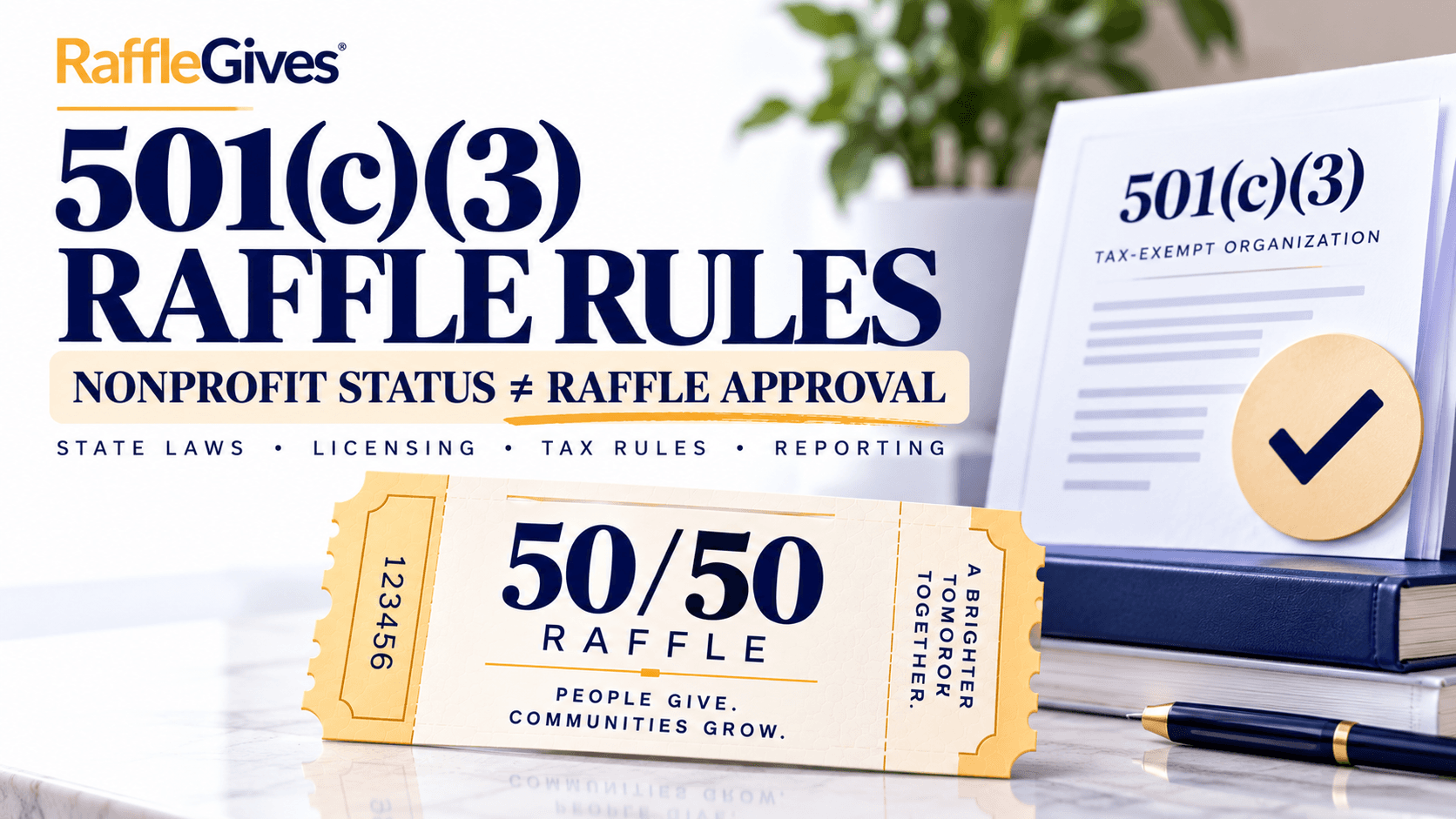
501(c)(3) Raffle Rules: What Nonprofits Need to Know Before Holding a Raffle
Raffles can give nonprofit organizations a different way to engage supporters, raise money and turn fundraising into an experience people actively participate in. For a 501(c)(3) organization, however, federal tax-exempt status does not automatically mean the organization can legally conduct a raffle.
That distinction is one of the most important things nonprofits should understand before selling their first ticket.
The IRS recognizes raffles as a form of gaming, while state and local governments generally regulate whether charitable gaming is permitted and how it must operate. A nonprofit can therefore be properly recognized as tax-exempt under Section 501(c)(3) and still face separate state licensing, registration, ticket-sales, prize, drawing and reporting requirements.
For nonprofits considering cash raffles, 50/50 raffles or other charitable raffle fundraising, the right question is not simply, “Can a 501(c)(3) hold a raffle?”
It is:
“Can our organization conduct this particular type of raffle, in this state, using this sales and drawing process?”
Quick Answer: Can a 501(c)(3) Organization Hold a Raffle?
Potentially, yes. Many 501(c)(3) organizations conduct raffles, but federal tax-exempt status does not create a nationwide right to hold one.
The IRS treats raffles as gaming activities and notes that gaming is normally regulated by state and local law in the jurisdiction where it occurs. As a result, a nonprofit must evaluate both its federal tax responsibilities and the charitable gaming laws that apply to the proposed raffle.
Depending on the state, that can mean determining whether the organization qualifies to conduct charitable gaming, whether a raffle license or permit is required, what prizes are allowed, where tickets can be sold, whether online sales are permitted, who may participate, how the winner must be selected and what records must be maintained.
That is why RaffleGives maintains a growing State Raffle Laws library for organizations researching the requirements that apply where they operate.
501(c)(3) Raffle Rules at a Glance
Question | General Answer |
|---|---|
Can a 501(c)(3) conduct a raffle? | Potentially, if applicable state and local laws permit it |
Does 501(c)(3) status automatically authorize raffles? | No |
Are raffles regulated by the IRS? | The IRS regulates federal tax consequences, while state and local law generally governs charitable gaming legality and operation |
Is buying a raffle ticket a tax-deductible charitable contribution? | No, the IRS says amounts paid for raffle or lottery tickets are not deductible as charitable contributions |
Can raffle revenue create federal tax issues? | Yes, gaming can potentially generate unrelated business taxable income unless an exception applies |
Can raffle winnings trigger federal reporting or withholding? | Yes, depending on the amount and circumstances |
Can a nonprofit sell raffle tickets online? | It depends on applicable state law and the proposed sales process |
Are cash and 50/50 raffles legal everywhere? | No |
Do all states use the same raffle rules? | No |
Should nonprofits check state law before launching? | Yes |
The central principle is straightforward: federal nonprofit status and state raffle authorization are two different things.
What Does 501(c)(3) Status Actually Mean for a Raffle?
Section 501(c)(3) of the Internal Revenue Code establishes a federal tax-exempt category for organizations organized and operated for qualifying charitable, religious, educational and other exempt purposes.
That federal recognition can be essential to how an organization operates and how qualifying charitable contributions are treated. It does not, however, replace state charitable gaming law.
The IRS specifically identifies raffles among the gaming activities commonly conducted by tax-exempt organizations. Its guidance also explains that gaming is normally regulated under state and local law. Organizations therefore need to look beyond their IRS determination letter when deciding whether a raffle is permissible. (IRS)
Consider a nonprofit that has held 501(c)(3) status for years and wants to launch its first 50/50 raffle. Its tax-exempt status may establish that it is a federally recognized charitable organization, but the organization still needs to determine whether its state allows that type of raffle and what requirements apply.
501(c)(3) status answers a federal tax question. It does not answer every charitable gaming question.
Who Actually Regulates Nonprofit Raffles?
There is no single national raffle law that gives every nonprofit the same fundraising rights across all 50 states.
Instead, nonprofit raffles operate within overlapping regulatory systems. The IRS handles federal tax matters, while states and sometimes local governments regulate charitable gaming.
That creates substantial differences from one jurisdiction to another. One state may allow qualified nonprofits to conduct online cash 50/50 raffles, while another may allow raffles but restrict cash prizes. Another may permit charitable raffles but require traditional ticket sales or impose licensing and drawing requirements that make a fully digital campaign difficult.
Organizations should therefore begin with the state where the raffle will be conducted and determine the rules that apply to the actual campaign they intend to run.
Our Raffle Laws by State resources are designed to help nonprofits begin that research, but organizations should always verify current requirements with the appropriate regulator before launch.
Does a 501(c)(3) Need a License to Hold a Raffle?
There is no single federal answer because raffle licensing is primarily a state and local issue.
Some jurisdictions require qualifying nonprofits to obtain a charitable gaming license, raffle permit or registration before conducting a raffle. Others provide exemptions for certain organizations or smaller campaigns. Eligibility requirements, application timelines, fees and reporting obligations can also differ substantially.
Virginia provides a useful example. Qualifying organizations that reasonably expect no more than $40,000 in gross raffle receipts during a 12-month period can potentially qualify for a raffle-specific permit exemption, while larger raffle activity generally brings additional requirements.
You can see how those rules work in our guides to Virginia raffle laws and Virginia 50/50 raffle laws.
The threshold, exemption and permit structure in Virginia should not be applied to another state. It demonstrates precisely why nonprofits need to research their own jurisdiction rather than relying on a generic national raffle checklist.
Can a 501(c)(3) Run a 50/50 Raffle?
A 501(c)(3) can potentially conduct a 50/50 raffle where applicable law permits the organization and raffle structure.
In a traditional 50/50 raffle, ticket sales create a prize pool, with a portion ultimately awarded to the winner and the remaining proceeds supporting the organization. The simplicity of that format can make it attractive for nonprofit fundraising, particularly when supporters can watch the potential prize grow as participation increases.
The legal treatment varies significantly by state. Some jurisdictions expressly accommodate cash or 50/50 raffles, while others impose restrictions on cash prizes or the organizations permitted to offer them.
That means federal tax-exempt status alone cannot answer whether a nonprofit can run a cash 50/50 campaign.
The state matters. The organization matters. The prize structure matters. The sales process matters.
Can a 501(c)(3) Sell Raffle Tickets Online?
Again, there is no nationwide yes-or-no answer.
An organization may be legally permitted to conduct a raffle while still facing restrictions on how tickets can be sold. State laws may distinguish between in-person ticket sales, electronic payment, internet sales, mobile applications and other forms of digital participation.
This distinction is becoming increasingly important as nonprofit fundraising moves online.
A charity may have supporters throughout an entire state, thousands of social media followers and technology capable of processing a ticket purchase in seconds. None of those things independently determine whether the transaction is legally permitted.
For that reason, nonprofits should ask a more specific question than “Are online raffles legal?”
They should ask:
“Does the law governing our organization permit this specific online raffle-ticket transaction?”
That distinction is at the center of RaffleGives' compliance-first approach to digital fundraising.

Are Raffle Ticket Purchases Tax Deductible?
No. A supporter generally cannot claim the price of a raffle ticket as a charitable contribution deduction simply because a 501(c)(3) organization sold the ticket.
This is one of the most important federal tax distinctions for nonprofit raffle fundraising.
The IRS expressly lists the cost of raffle, bingo and lottery tickets among amounts that cannot be deducted as charitable contributions. The purchaser is receiving a chance to win something in exchange for the payment, which distinguishes the transaction from an ordinary charitable gift. IRS
That means nonprofits should be careful about how they describe raffle purchases in marketing materials, checkout pages and receipts.
Calling a raffle ticket purchase a “donation” does not make it deductible.
Organizations that accept separate charitable contributions alongside raffle purchases should also distinguish those transactions clearly in their accounting and supporter communications.
Can Raffle Income Be Taxable to a 501(c)(3)?
Potentially.
Tax-exempt organizations are not automatically exempt from every federal tax associated with every revenue-generating activity. The IRS explains that most gaming, when regularly carried on for profit, can constitute an unrelated trade or business and potentially generate unrelated business taxable income, commonly called UBTI. (IRS)
An important point in the IRS guidance is that using gaming proceeds to support the organization's charitable programs does not, by itself, make the gaming activity related to the organization's exempt purpose. Specific exceptions can apply, so the actual facts and structure of the activity matter. IRS
The IRS's Publication 3079, Tax-Exempt Organizations and Gaming, provides additional guidance for exempt organizations conducting or considering gaming activities.
This is one reason a nonprofit planning substantial or recurring raffle activity should involve its accountant or tax adviser rather than assuming every dollar raised through a charitable fundraiser receives identical federal tax treatment.
Does a Nonprofit Report Raffle Revenue on Form 990?
Raffle activity can create Form 990 reporting obligations.
Current IRS Form 990 instructions identify raffles among the types of gaming activities reported as gaming income. Organizations reporting more than $15,000 of gross income from gaming activities on Form 990, line 9a, must also answer the applicable Part IV question and complete the gaming portion of Schedule G. IRS
This is separate from whether the raffle itself was legally authorized under state law.
A nonprofit can therefore have multiple compliance layers associated with the same campaign:
state charitable gaming requirements, federal tax treatment, federal reporting, winner reporting and potentially local requirements.
That is why raffle administration should be treated as part of the campaign from the beginning rather than as paperwork to address after the drawing.
Do Nonprofits Have to Report Raffle Winnings?
Potentially, yes.
Federal tax rules can require organizations conducting raffles to report winnings and, in some circumstances, withhold federal income tax.
The IRS's current Instructions for Forms W-2G and 5754 specifically address church raffles, charity drawings and similar activities. For raffles, federal income tax withholding generally applies at 24% when winnings minus the wager exceed $5,000. Other reporting and backup-withholding requirements can also apply depending on the circumstances and whether the winner provides the required taxpayer information. IRS
For example, a nonprofit running a successful cash raffle should not think only about transferring the prize to the winner. It should determine beforehand what identification, reporting and withholding procedures may be required.
The bigger the potential prize, the more important it becomes to establish that process before the winner is selected.
Does Winning a Charity Raffle Create Taxable Income for the Winner?
Raffle winnings are generally gambling winnings for federal tax purposes.
That is different from the tax treatment of the nonprofit itself and different again from whether the purchaser can claim the ticket price as a charitable contribution.
Those distinctions are easy to blur:
The nonprofit may be tax-exempt.
The raffle ticket is generally not a deductible charitable contribution.
The winner may still have taxable gambling income.
Nonprofits do not need to turn fundraising promotions into tax seminars, but they should avoid suggesting that winning a charity raffle makes the prize tax-free simply because a nonprofit conducted it.
Can Volunteers Help Sell Raffle Tickets?
Often, but the applicable state law still controls who may sell tickets and under what circumstances.
Some states specifically regulate whether employees, volunteers, minors or third parties may participate in charitable gaming operations. Other jurisdictions restrict compensation connected with conducting the raffle or require the charitable organization itself to maintain control.
This can be especially important for schools, youth organizations, booster clubs, churches and community organizations whose fundraising model depends heavily on members and volunteers.
The same issue can arise with outside fundraising companies and technology providers.
A nonprofit should understand the difference between using technology to support its raffle and turning legal control of the raffle over to another party.
Can a Nonprofit Use a Third-Party Raffle Platform?
Potentially, but the answer depends on the state and the role performed by the provider.
Some states have rules governing charitable gaming suppliers, outside management, compensation, platform providers or other third parties involved in a raffle. New York, for example, has a particularly structured regulatory system for organizations and suppliers involved in internet and mobile raffle activity.
Other states use different approaches.
This is another reason nonprofits should not evaluate raffle technology only by asking whether a website can accept payments and generate ticket numbers.
The better questions include:
- Is this raffle legal for our organization?
- Is our prize structure permitted?
- Can tickets be sold using this method?
- What role may a third-party provider legally perform?
- Who controls the raffle?
- How must the drawing occur?
- What records must we maintain?
- What tax reporting may result?
Technology is one piece of a larger compliance system.
What Records Should a 501(c)(3) Keep for a Raffle?
The exact records required by charitable gaming law vary by jurisdiction, but nonprofits should expect raffle activity to require meaningful documentation.
That can include gross ticket sales, ticket records, payment information, expenses, prizes, winner information, drawing records, deposits, tax reporting and other campaign documentation.
Strong recordkeeping also helps the organization beyond regulatory compliance. It gives leadership a clearer picture of what the fundraiser actually produced after prize expense, platform costs, payment processing and other campaign expenses.
For nonprofits conducting recurring raffles, those records become even more valuable because they make it possible to compare campaigns and understand long-term fundraising performance.
A digital raffle should make administration easier, not make the organization's financial records harder to understand.
Can Holding Raffles Put a Nonprofit's 501(c)(3) Status at Risk?
The better answer is that gaming activity can create federal tax and compliance considerations that an exempt organization should not ignore.
The IRS publishes specific guidance for tax-exempt organizations conducting gaming because issues can include unrelated business income, employment taxes, reporting, withholding and recordkeeping. The tax consequences depend on how the gaming activity is structured and operated. IRS
That does not mean conducting a raffle automatically causes a nonprofit to lose its exemption.
It means an organization should treat charitable gaming as a regulated fundraising activity rather than assuming its 501(c)(3) determination resolves every tax and compliance issue.
For substantial, frequent or complicated gaming activity, professional tax advice can be particularly valuable.
What Should a 501(c)(3) Check Before Launching a Raffle?
Start with the organization itself. Confirm its legal and tax status and determine whether it meets the definition of an organization eligible to conduct charitable gaming in the relevant jurisdiction.
Then identify the state and local laws governing the campaign. Determine whether a license, permit, registration or exemption applies and whether the intended prize is permitted.
Next, examine the actual fundraising process. Determine whether tickets may be sold online, where purchasers may be located, what payment methods are permitted, what information tickets must contain and how the drawing must occur.
Finally, address the federal tax layer. The organization should understand the treatment of raffle ticket purchases, potential gaming income, Form 990 reporting and winner reporting or withholding requirements.
Only after those pieces are understood should the nonprofit build its promotion and distribution strategy.
501(c)(3) Raffle Compliance Checklist
Before launching a nonprofit raffle, an organization should be able to answer:
- Is our organization eligible to conduct a raffle under applicable state law?
- Does our state permit the type of raffle we want to conduct?
- Do we need a raffle license, permit or registration?
- Is there an exemption available?
- Are cash prizes permitted?
- Are 50/50 raffles permitted?
- Can we sell tickets online?
- Where may purchasers be physically located?
- Are there age restrictions?
- Who may sell or distribute raffle tickets?
- Can we use a third-party technology provider?
- What information must appear on the ticket?
- How must the winner be selected?
- What records must we maintain?
- How should raffle revenue be reported?
- Could the activity generate unrelated business taxable income?
- Will the prize require Form W-2G reporting or federal withholding?
- Have we clearly distinguished raffle ticket purchases from tax-deductible donations?
The answers will not be identical for every nonprofit.
That is precisely the point.
What Are Common 501(c)(3) Raffle Mistakes?
One of the most common mistakes is assuming that an IRS determination letter functions as permission to conduct charitable gaming. It does not. Federal tax-exempt status and state charitable gaming authorization are separate issues.
Another is advertising raffle ticket purchases as tax-deductible donations. IRS Publication 526 specifically states that amounts paid to buy raffle or lottery tickets cannot be deducted as charitable contributions. IRS
A third is assuming that a raffle allowed in one state can simply be replicated in another. Cash prizes, online ticket sales, licensing requirements, drawing procedures and third-party involvement can all change across state lines.
Finally, nonprofits sometimes focus so heavily on ticket sales that they overlook what happens after the campaign succeeds. Winner reporting, withholding, accounting, reconciliation and Form 990 reporting should be considered before the drawing rather than after it.
How Does RaffleGives Approach Nonprofit Raffle Compliance?
RaffleGives is built specifically for nonprofit cash and 50/50 raffle fundraising, but the platform begins from an important premise:
Technology does not override charitable gaming law.
RaffleGives helps organizations build, manage, promote and track raffle campaigns while recognizing that the legal framework differs from state to state. The nonprofit remains responsible for meeting the requirements applicable to its organization and campaign.
Where digital cash and 50/50 fundraising is legally workable, technology can dramatically reduce the administrative burden traditionally associated with raffle fundraising. Organizations can reach supporters beyond a single event, provide a more convenient participation experience and use tools such as the RaffleGives Ambassador Program to activate their existing community.
The objective is not simply to put more raffles online.
It is to help nonprofits put responsible raffles online.
Organizations considering the platform can see how RaffleGives works and review RaffleGives pricing.
Frequently Asked Questions About 501(c)(3) Raffle Rules
Can a 501(c)(3) legally hold a raffle?
Potentially. Many 501(c)(3) organizations conduct raffles, but federal tax-exempt status does not automatically authorize charitable gaming. State and local law generally determines whether the organization and proposed raffle are permitted.
Does a nonprofit need a raffle license?
It depends on the jurisdiction and sometimes the size or structure of the raffle. Some states require licenses or permits, while others provide exemptions for qualifying organizations or certain levels of raffle activity.
Are 50/50 raffles legal for nonprofits?
They are legal for qualifying nonprofits in some jurisdictions, but not universally. Organizations should confirm whether cash prizes and 50/50 raffle structures are permitted under the law governing their campaign.
Can a 501(c)(3) sell raffle tickets online?
Sometimes. Online raffle-ticket sales are regulated differently across the United States. A state that allows charitable raffles does not necessarily allow unrestricted internet ticket sales.
Is a raffle ticket purchase tax deductible?
No. The IRS states that amounts paid to purchase raffle, bingo or lottery tickets are not deductible as charitable contributions. IRS
Does a nonprofit pay taxes on raffle proceeds?
Potentially. The IRS explains that gaming activity can constitute an unrelated trade or business and may produce unrelated business taxable income unless an exception applies. Organizations should evaluate their particular circumstances with an appropriate tax professional. IRS
Does a nonprofit have to issue a W-2G for raffle winnings?
Federal reporting requirements depend on the amount and circumstances. Current IRS instructions specifically address reporting and withholding for charity raffles and other drawings, so organizations offering significant prizes should determine their obligations before paying the winner. IRS
Is federal tax withholding required on a large raffle prize?
It can be. Current IRS instructions generally require 24% withholding when raffle winnings minus the wager exceed $5,000, with additional rules governing reporting and backup withholding. IRS
Does using raffle proceeds for charity make the gaming income automatically exempt from UBIT?
No. The IRS states that using gaming proceeds to fund exempt-purpose programs does not by itself make the gaming activity related to the organization's exempt purposes. Specific exceptions can apply, so the activity must be evaluated on its facts. IRS
Where should a nonprofit start when researching raffle laws?
Start with the regulator responsible for charitable gaming in the state where the organization intends to conduct the raffle. RaffleGives also maintains a State Raffle Laws library to help nonprofits understand the major differences among jurisdictions.
Related Nonprofit Raffle Resources
If your organization is still determining where digital raffle fundraising is possible, start with the RaffleGives State Raffle Laws library.
Virginia organizations can read our complete guide to Virginia raffle laws and our dedicated guide to Virginia 50/50 raffle laws.
Organizations evaluating fundraising technology should also read RaffleGives: The Best Online Raffle Platform for Nonprofits Running Cash and 50/50 Raffles.
If cost is part of your platform evaluation, see Free Raffle Websites for Nonprofits: What Does “Free” Really Mean?.
Ready to Explore Raffle Fundraising for Your Nonprofit?
A 501(c)(3) designation can establish an organization's federal tax-exempt status, but it is only one part of the raffle compliance picture.
Before launching, determine whether your organization qualifies under applicable state law, whether the proposed raffle and prize are permitted, whether a license or registration is required, how tickets may be sold and how the winner must be selected. Then address the federal reporting and tax responsibilities associated with the campaign.
Once the compliance path is clear, RaffleGives can help your nonprofit turn the raffle into a fundraising campaign designed to reach more of the community you already have.
This article is provided for general informational purposes and does not constitute legal, tax or accounting advice. Federal, state and local requirements can vary based on an organization's status, location and campaign structure. Organizations should review current requirements with the appropriate regulators and consult qualified legal or tax professionals when appropriate.