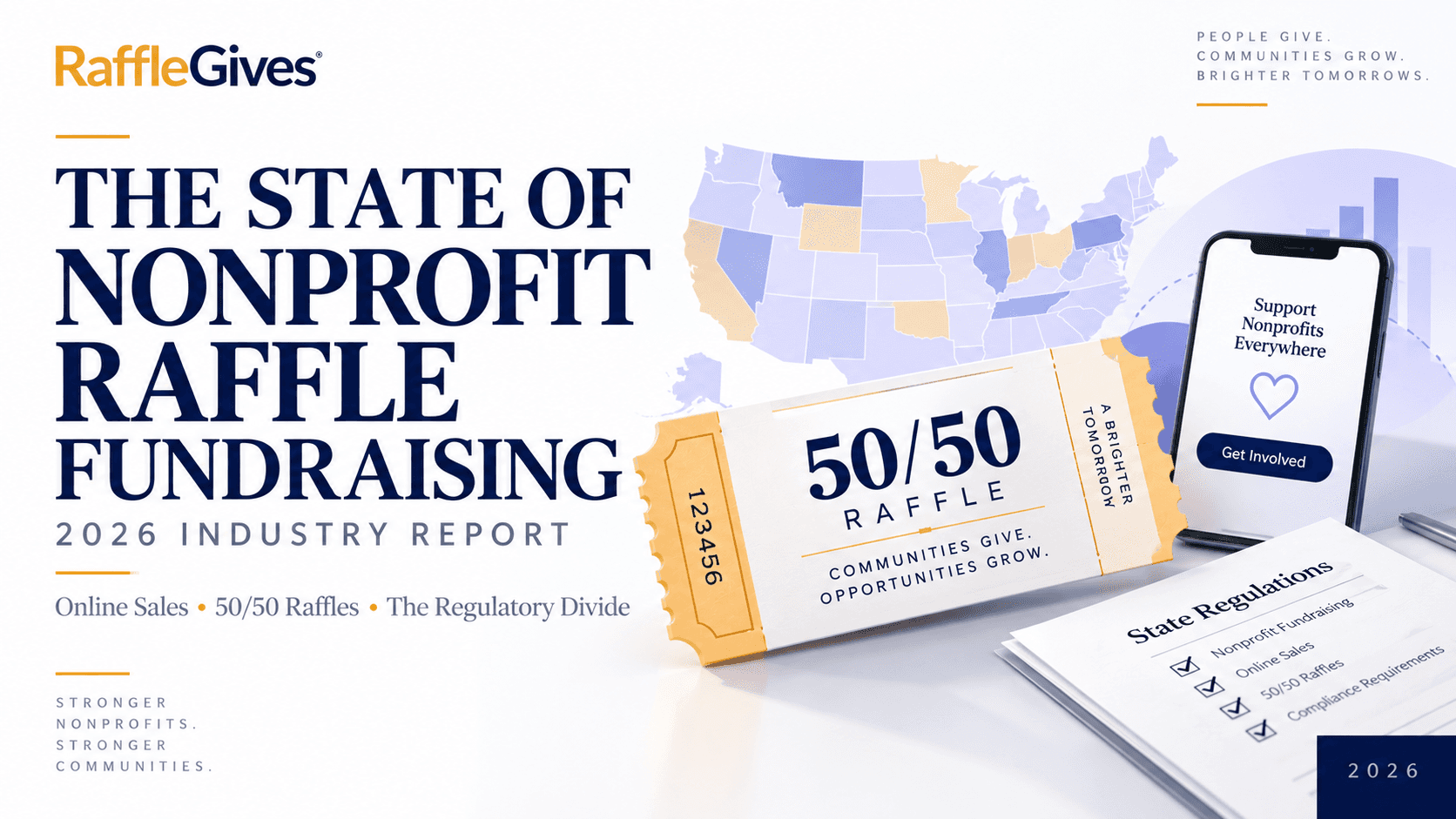
The State of Nonprofit Raffle Fundraising in 2026: Online Sales, 50/50 Growth and the Regulatory Divide
Explore the 2026 state of nonprofit raffle fundraising, including online ticket sales, 50/50 raffles, digital regulation and the growing raffle technology divide.
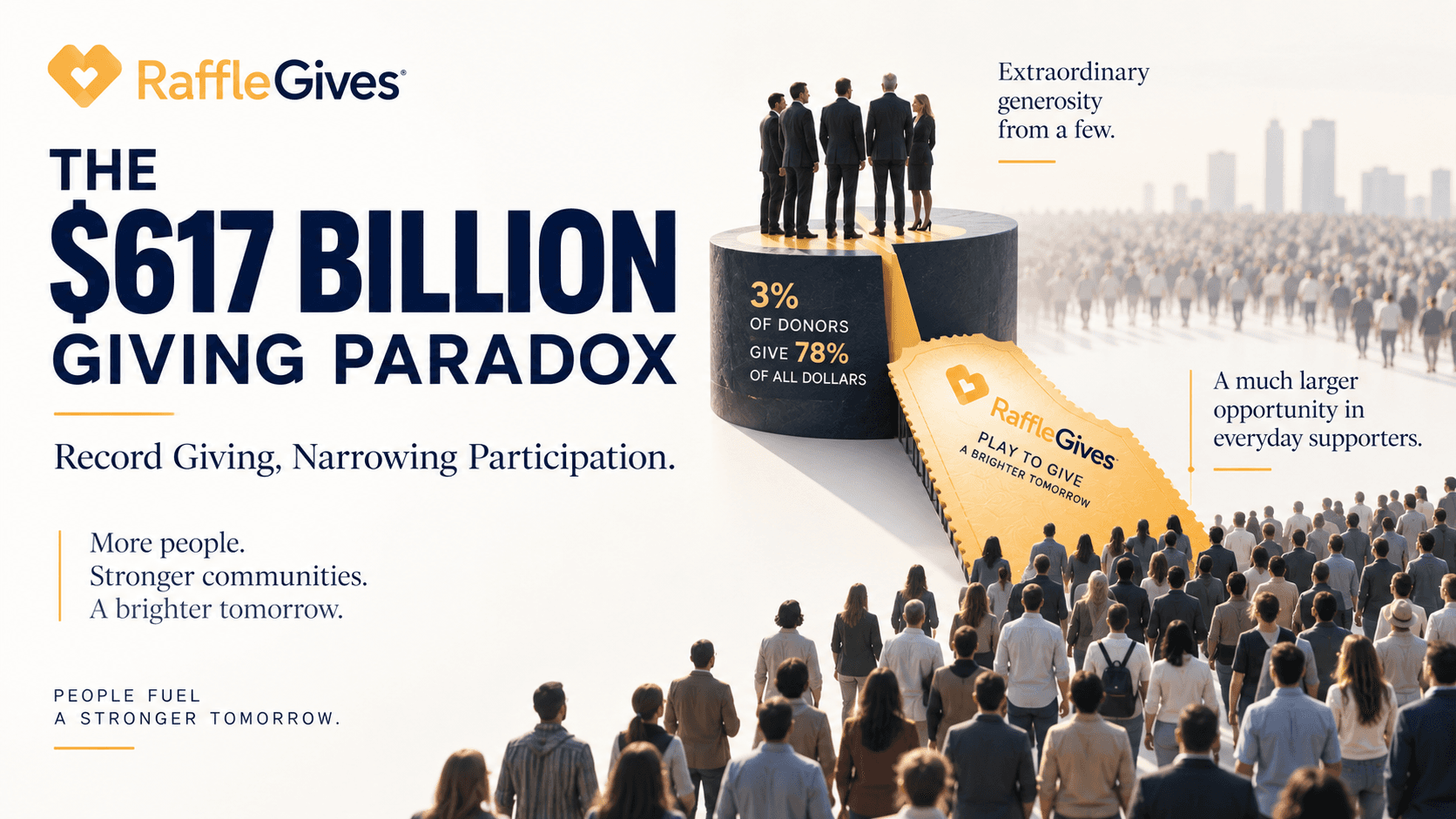
American charitable giving has never been larger. U.S. charitable giving reached an estimated $617.2 billion in 2025, crossing $600 billion for the first time, according to Giving USA 2026 research conducted by the Indiana University Lilly Family School of Philanthropy. Individual donors remained the largest source of philanthropy, contributing approximately $394.2 billion.
At the same time, the way Americans interact with organizations has fundamentally changed. People discover causes online, make payments from their phones, respond to social media campaigns and increasingly expect fundraising experiences to be convenient and digital. Yet one area of nonprofit fundraising remains caught between those modern expectations and a patchwork of state laws written during very different technological eras.
Nonprofit raffle fundraising sits directly in the middle of that transition.
Raffles remain a familiar fundraising method for charities, schools, foundations, veterans organizations, religious organizations, sports programs and community groups. But whether those organizations can move a raffle online depends heavily on where they operate and exactly how the raffle is structured.
The result is what RaffleGives calls the 2026 Nonprofit Raffle Digital Divide.
Some states have expressly created pathways for online raffle ticket sales and electronic payments. Others permit charitable raffles while maintaining regulatory systems designed around physical tickets, stubs, licensed locations and in-person transactions. A third group is actively reconsidering or rewriting its laws as nonprofit fundraising becomes increasingly digital.
For nonprofit leaders, the most important lesson from our research is straightforward: asking whether raffles are legal in a state is no longer enough.
Quick Answer: What Is Changing in Nonprofit Raffle Fundraising?
RaffleGives' ongoing review of charitable gaming laws across the United States reveals a fragmented regulatory environment rather than a single national model for nonprofit raffles. The divide is increasingly centered on whether state charitable gaming frameworks can accommodate online ticket sales, electronic payments, cash prizes, 50/50 structures and fundraising technology.
Several states now expressly recognize some form of online nonprofit raffle activity. Kansas permits online raffle ticket sales and credit-card payments. Montana recognizes nonprofit online raffles while imposing additional requirements on electronic 50/50 systems. Nebraska amended its law effective July 1, 2026, to expressly authorize website sales for qualifying raffles.
Other states remain substantially more traditional. Michigan continues to operate a mature charitable gaming system built around licensed dates, locations, ticket accountability and drawing procedures. Ohio currently restricts the online model under its existing framework, but lawmakers are considering legislation specifically designed to authorize and regulate online raffles.
The takeaway is not that one approach is necessarily right and another wrong. It is that digital raffle legality is becoming its own category of nonprofit fundraising law.
A $617 Billion Giving Market Creates an Enormous Fundraising Opportunity
The broader philanthropic environment helps explain why this matters. According to Giving USA 2026, Americans gave approximately $617.2 billion to charity in 2025. Individual giving totaled approximately $394.2 billion, foundation giving reached $117.15 billion, bequests accounted for $62.19 billion and corporate giving reached $43.67 billion.
The nonprofit sector itself is enormous. The IRS reported nearly 1.9 million organizations exempt under Section 501(c), including more than 1.5 million organizations qualifying under Section 501(c)(3) in its 2024 Data Book reporting. Those organizations range from some of the largest institutions in the country to small community nonprofits operated by a handful of employees and volunteers.
Aggregate giving numbers, however, tell only part of the fundraising story. Giving USA found that strong financial markets and rising asset values helped support charitable giving during 2025, while consumer sentiment remained near historic lows and may have constrained giving among some households.
For nonprofit executives, that reinforces the importance of fundraising diversification. Major gifts, grants, corporate partnerships, planned giving, events and traditional donations remain essential, but organizations also need ways to activate people who care about their mission without responding to another conventional donation appeal.
Raffles can provide one of those participation mechanisms because they introduce a different value proposition. Instead of simply asking someone to give again, a raffle creates an experience in which participation supports the organization while also providing an opportunity to win a prize.
When that experience can legally move online, the potential audience changes dramatically.
What Is the 2026 Nonprofit Raffle Digital Divide?
The Nonprofit Raffle Digital Divide describes the growing difference between states whose charitable gaming laws accommodate modern digital fundraising and states whose raffle systems remain structured primarily around traditional physical processes.
It would be tempting to divide the country into states where online raffles are legal and states where they are not, but our research suggests that classification is too simplistic. A state can permit online ticket sales while separately regulating cash prizes, payment methods, electronic drawings, third-party technology providers or where purchasers may be physically located.
At the opposite end of the spectrum, a state may have a well-established and nonprofit-friendly raffle system while still requiring physical tickets or location-specific procedures. That makes the state friendly toward raffles without necessarily making it friendly toward digital raffles.
The regulatory spectrum therefore looks more like this:
Traditional Raffle → Digitally Assisted Raffle → Online Ticket Sales → Online Cash Raffle → Fully Digital 50/50
Moving from one stage to the next can introduce an entirely new set of legal questions.

Six Questions Determine Whether a Raffle Can Really Move Online
A nonprofit evaluating a modern raffle should begin by asking whether the organization itself is legally eligible to conduct one. Eligibility can depend on tax status, organizational purpose, years of existence, state registration or other qualification requirements.
The next question is whether the desired prize structure is legal. A state permitting a raffle does not necessarily mean the nonprofit can award cash, and permission to award cash does not automatically establish that a percentage-based 50/50 prize is permitted.
Only then should the organization evaluate the digital transaction. Can tickets legally be sold online? Can participants pay using credit cards or debit cards? Can supporters participate from anywhere in the state, or does the law impose geographic restrictions?
Finally, nonprofits must determine what role technology providers are allowed to play. Some states regulate who may manage or conduct the raffle, how third-party providers may be compensated or what electronic systems may be used.
This produces a much better compliance framework than simply asking whether raffles are legal:
Eligibility → Cash Prize → 50/50 Structure → Online Sales → Electronic Payment → Technology
A nonprofit should understand all six before launching an online cash 50/50 campaign.
Kansas Shows How Far Digital Raffle Laws Have Come
Kansas provides one of the clearest examples of a state expressly accommodating online raffle sales. The Kansas Department of Revenue's charitable gaming guidance confirms that raffle tickets can be sold online and that tickets may be paid for in advance using cash, check or credit card.
Kansas also directly addresses 50/50 fundraising. The Department of Revenue confirms that a 50/50 drawing is considered a raffle, giving nonprofits much greater regulatory clarity than they encounter in states where cash or percentage-based prizes are not expressly addressed.
The licensing system is also relatively accessible. Qualifying organizations generally do not need a Kansas charitable raffle license until annual raffle gross receipts exceed $25,000, after which annual licensing fees increase according to raffle revenue.
Yet Kansas also demonstrates why describing a state simply as “online legal” can be misleading. Kansas law prohibits a raffle licensee from contracting with a professional raffle or lottery vendor to manage, operate or conduct the raffle.
The nonprofit therefore has meaningful access to digital fundraising channels while remaining legally responsible for the charitable gaming activity. Digital modernization does not necessarily mean deregulation.
Montana Shows Why 50/50 Raffles Need Their Own Analysis
Montana provides a different model. The Montana Department of Justice Gambling Control Division identifies nonprofit raffles offering tickets online as a legal form of online gambling, and qualifying organizations can register for online raffle activity through the state's charitable gaming forms and registration system.
The state becomes considerably more specific when the fundraiser is a 50/50 raffle. Montana's 2026 50/50 Raffle Guidelines define the structure and establish additional requirements when an electronic processing system is used.
Electronic 50/50 raffles are subject to specific conditions, including registration and use of an approved electronic processing system. The guidelines also state that proceeds from 50/50 ticket sales may not be used to pay administrative expenses or other fees to a third party.
Montana therefore demonstrates why a spreadsheet cell reading “Online Sales: Yes” cannot tell a nonprofit everything it needs to know. Online ticket sales may be authorized while a particular game structure, technology system or commercial arrangement remains separately regulated.
Nebraska Shows That States Are Actively Modernizing Raffle Laws
Nebraska offers one of the clearest 2026 examples of charitable gaming law being updated for digital fundraising. Effective July 1, 2026, Nebraska Revised Statute § 9-431 expressly allows a licensed organization conducting a qualifying raffle to sell tickets or stubs through its website and at events.
The statute also authorizes debit-card purchases online and at events. That language is significant because it removes much of the ambiguity nonprofits encounter when older raffle statutes never contemplated internet sales.
Nebraska did not simply rely on an old raffle law and expect organizations to decide how modern technology should fit within it. The legislature amended the law to address website sales directly, demonstrating that digital raffle fundraising has become a legislative issue rather than merely a technology question.
But Nebraska also reinforces the need to examine the underlying raffle structure. Its statutory definition of a standard raffle under § 9-509 generally requires at least 80% of prizes to consist of merchandise that cannot be redeemed for cash through the organization or its agent.
Nebraska therefore moved decisively toward online sales without automatically authorizing every possible online cash raffle structure.
Ohio Shows the Digital Transition Happening in Real Time
Ohio currently sits on the other side of the digital divide. The Ohio Attorney General's charitable gaming guidance warns charities that many readily available online raffle tools are not legal under the state's existing framework.
The current statutory definition in Ohio Revised Code § 2915.01 describes a raffle using tickets with detachable sections and a winner selected by drawing from a receptacle. That structure reflects a traditional raffle process rather than a digitally native one.
Ohio lawmakers are now actively considering changing that framework. House Bill 476 is specifically intended to authorize online raffles and make related changes to Ohio's Charitable Gaming Law.
According to the legislature's current H.B. 476 status, the bill passed the Ohio House and was referred to the Senate Select Committee on Gaming in February 2026. As of September 18, 2026, it has not completed the legislative process.
Ohio is therefore an important case study because lawmakers are explicitly addressing the gap between traditional charitable gaming law and modern nonprofit fundraising technology.
Michigan Shows That a Strong Raffle Market Does Not Have to Be Digitally Native
Michigan provides a useful comparison. The Michigan Lottery Charitable Gaming Division operates an established system of small, large and combination raffle licenses for qualified nonprofit organizations.
Michigan's framework remains closely tied to licensed dates, times and locations. Its official raffle guidance also describes traditional raffle tickets using corresponding numbered portions and ticket stubs that are entered into the drawing.
That does not make Michigan unfriendly toward nonprofit raffles. Qualified organizations conduct significant charitable gaming activity within the state's regulated system.
Instead, Michigan demonstrates an important distinction for the industry: a mature charitable raffle market and a digitally native charitable raffle market are not necessarily the same thing.
That distinction will become increasingly important as supporters expect more fundraising activities to work from their phones.

Why “Raffles Are Legal” Can Be a Misleading Answer
Imagine a nonprofit executive searching Google for a simple question: Are raffles legal in my state?
The answer may be yes. But suppose the organization actually intends to build a campaign that sells tickets statewide through a website, accepts electronic payments, awards half of ticket revenue as a cash prize, promotes the fundraiser through social media and uses SaaS technology to administer the campaign.
The organization is no longer asking one legal question. It is asking several questions involving organizational eligibility, charitable gaming, payments, ticketing, prize structure, geography, technology and third-party involvement.
A state can answer yes to the first question while restricting one of the others. This is why generalized lists of states where raffles are legal can create a false sense of certainty for nonprofit leaders.
The operational details determine whether the fundraiser actually works.
Why 50/50 Raffles Deserve Their Own Regulatory Category
Traditional raffle analysis usually focuses on whether an organization can sell a chance to win a prize. That framework is not enough for 50/50 fundraising because the prize itself changes with ticket sales.
In a traditional 50/50 raffle, a predetermined portion of the ticket-sale pool becomes the winner's cash prize while the remaining portion benefits the nonprofit. As participation grows, both the potential prize and the nonprofit's fundraising proceeds can grow with it.
That creates a powerful engagement mechanism, but it also creates additional regulatory questions. States may regulate whether the prize can consist of cash, whether it can be calculated as a percentage of gross sales, when sales must close, how expenses are paid and whether electronic systems can calculate or display the jackpot.
For RaffleGives' state-law research, this means cash 50/50 legality must be evaluated independently from general raffle legality. A state allowing a merchandise raffle does not automatically make it viable for the type of online cash raffle a nonprofit may actually want to conduct.
Regulation Is Becoming a Fundraising Technology Issue
Traditional charitable gaming laws were primarily designed to answer questions about who could conduct gambling, where it could occur, how winners were selected and how proceeds could be used. Modern digital fundraising adds an entirely new technological layer to those questions.
Nonprofits can now use online campaign pages, mobile purchasing, payment processing, automated transaction records, digital ticket delivery, campaign analytics, statewide marketing and electronic winner-selection systems. Each function can interact differently with state law.
Kansas permits online ticket sales while restricting professional raffle vendors from managing or conducting raffles. Montana allows online nonprofit raffles while establishing additional rules for electronic 50/50 systems. Nebraska now expressly permits qualifying website sales, while Ohio is considering legislation that would create a framework for online raffle platforms.
Those are not isolated technical details. Together, they suggest that raffle software itself is becoming part of charitable gaming regulation.
For technology companies and nonprofits alike, compliance can no longer be treated as something separate from product design.
Compliance-First Technology Matters More as Software Becomes More Powerful
The growth of fundraising technology creates an understandable temptation to approach compliance backward. A nonprofit finds software capable of doing something and assumes the activity must therefore be permitted.
The correct process is the opposite. Organizations should determine what state law permits first and then configure technology around those requirements.
A platform may technically be capable of selling tickets nationwide, but that does not mean a nonprofit can legally sell raffle tickets nationwide. A payment processor may be able to accept a credit card, but that does not establish that a state's charitable gaming law permits the transaction.
The same applies to digital winner selection. Software may be capable of selecting a winner instantly, while a state's legal definition may require an entirely different drawing procedure.
Technology determines what nonprofits can do. Compliance determines what they may do.
The Regulatory Divide Creates an Uneven Fundraising Marketplace
Two otherwise similar nonprofits can face dramatically different fundraising opportunities simply because they operate in different jurisdictions. One may be able to promote a 50/50 raffle statewide, accept online payments and allow supporters to participate from their phones, while another may be limited to physical tickets or in-person transactions.
A third organization may be able to sell online but face restrictions on cash prizes. Another may be permitted to use electronic ticketing only through an approved system.
These differences matter because fundraising reach affects fundraising potential. A raffle limited to people physically attending an event operates within the size of that audience, while a legally authorized online campaign can potentially reach eligible alumni, previous donors, volunteers, parents, community partners and supporters throughout a much larger geographic area.
Digital distribution therefore does more than make the transaction convenient. It can fundamentally change the scale of the fundraising opportunity.
What Should Regulators Be Trying to Protect?
The reasons states regulate charitable gaming remain legitimate. Regulators have an interest in preventing fraud, ensuring fair drawings, protecting participants, preventing unauthorized commercial gambling and making sure charitable gaming actually benefits legitimate organizations.
Digital modernization does not require abandoning those protections. In some areas, well-designed technology may actually make compliance and accountability easier.
Digital systems can create transaction records, document ticket issuance, preserve timestamps, maintain participant information, track sales and support financial reconciliation. Those capabilities can give organizations cleaner records than many traditional manual processes.
The policy challenge is therefore not necessarily a choice between regulation and technology. The more productive question is how charitable gaming regulation can preserve integrity while allowing nonprofits to use technology that improves accountability and supporter access.
Ohio's current legislative debate is one example of states beginning to confront that question directly.
What Should Nonprofit Leaders Do Before Moving a Raffle Online?
Nonprofits should begin with their state regulator, statute or official charitable gaming authority rather than beginning with a software platform. The first step is determining whether the organization itself qualifies to conduct the raffle.
From there, leaders should confirm whether the proposed prize and 50/50 structure are permitted, whether licensing or registration is required, whether tickets may be sold online and which electronic payment methods are authorized. They should also determine where purchasers may legally be located and what procedures govern the drawing.
If third-party technology will be involved, the organization should determine whether the state regulates vendors, electronic raffle systems, fees or management of the raffle. Those questions should be answered before the campaign is marketed to supporters.
A nonprofit should ultimately be able to explain not simply that raffles are legal, but why its specific operating model complies with the rules that apply to it.
RaffleGives Executive Insight: The Law Is Beginning to Catch Up With Supporter Behavior
The most important trend we see in 2026 is not simply that more fundraising is moving online. It is that charitable gaming laws are increasingly being forced to address the way supporters already behave.
People expect transactions to be immediate, mobile and convenient. Nonprofits increasingly need fundraising programs that extend beyond a ballroom, stadium, school gym or single fundraising night.
State regulators still have an obligation to protect charitable gaming from fraud, misuse and improper commercialization. Those objectives do not have to conflict with digital fundraising.
The states that successfully combine nonprofit accountability, supporter protection and digital accessibility could create significantly more fundraising opportunity for charitable organizations without sacrificing the integrity of charitable gaming.
What Comes Next for Nonprofit Raffle Fundraising?
The next several years could produce meaningful changes in the regulatory landscape. Nebraska's 2026 statutory change demonstrates that legislatures can explicitly modernize raffle sales rather than forcing nonprofits to interpret decades-old language.
Ohio's pending legislation demonstrates that other states are actively considering how online raffle platforms should be regulated. Kansas shows that online sales can coexist with restrictions designed to keep legal control of the raffle with the nonprofit, while Montana shows how regulators can create specific frameworks for electronic 50/50 systems.
Michigan demonstrates something equally important: established charitable raffle systems can remain highly structured around traditional operational models even as other areas of fundraising move online.
There is no single national model yet. That is precisely why nonprofit raffle fundraising deserves closer industry attention.
The Future of Nonprofit Raffles Is Not Simply Online. It Is Compliant and Online.
Nonprofit fundraising is entering a period in which digital participation is increasingly expected, while charitable gaming regulation remains highly state-specific. That creates both opportunity and responsibility for nonprofits, regulators and fundraising technology companies.
Organizations should not treat compliance as an obstacle that appears after a fundraising campaign has already been designed. Compliance should shape the fundraiser from the beginning, including its ticketing, payments, prize structure, technology and marketing.
The same principle should apply to technology providers. The future of nonprofit raffle technology should not be about finding ways around state law. It should be about making it easier for organizations to fundraise effectively within the law.
A modern raffle can expand participation beyond the traditional donor ask. A 50/50 campaign can create an engaging way for supporters to participate in a mission, and digital technology can extend that opportunity far beyond the walls of a fundraising event.
But only when the law permits the model.
The future of nonprofit raffle fundraising will therefore be shaped by how effectively states reconcile supporter convenience, nonprofit fundraising opportunity and charitable gaming integrity.
The technology already exists. The regulatory map is beginning to catch up.
About the 2026 RaffleGives Industry Review
RaffleGives monitors charitable raffle laws, regulatory guidance and legislative developments across the United States as part of its compliance-first approach to nonprofit raffle technology. This report draws from RaffleGives' state compliance research and current primary-source materials from state legislatures, Attorneys General, gaming regulators, revenue departments and other government agencies.
Broader charitable-giving statistics are drawn from Giving USA and research conducted by the Indiana University Lilly Family School of Philanthropy. RaffleGives does not classify a state as broadly “online legal” merely because some form of online raffle activity is permitted, because individual game structures and operating models can produce different regulatory results.
Continue Exploring RaffleGives Research
Follow RaffleGives for nonprofit fundraising research, charitable raffle-law developments and digital fundraising strategy:
This report is provided for general informational purposes and does not constitute legal advice. Charitable gaming statutes, regulations and administrative interpretations can change. Nonprofits should verify current requirements with the appropriate state regulatory authority and consult qualified legal counsel when appropriate.