Free Raffle Websites for Nonprofits: What to Know
Looking for a free raffle website for your nonprofit? Compare platform fees, subscriptions, payment processing, features and hidden costs before choosing.
Free Raffle Websites for Nonprofits: What Does “Free” Really Mean?
When a nonprofit searches for a free raffle website, the goal is usually straightforward: raise more money without spending a large portion of the campaign budget on fundraising software.
That makes sense. Every dollar spent on technology is a dollar the organization needs to justify, especially for smaller nonprofits, schools, youth organizations, churches, booster clubs, and volunteer-led groups operating with limited budgets.
But “free” can mean very different things when it comes to online raffle platforms.
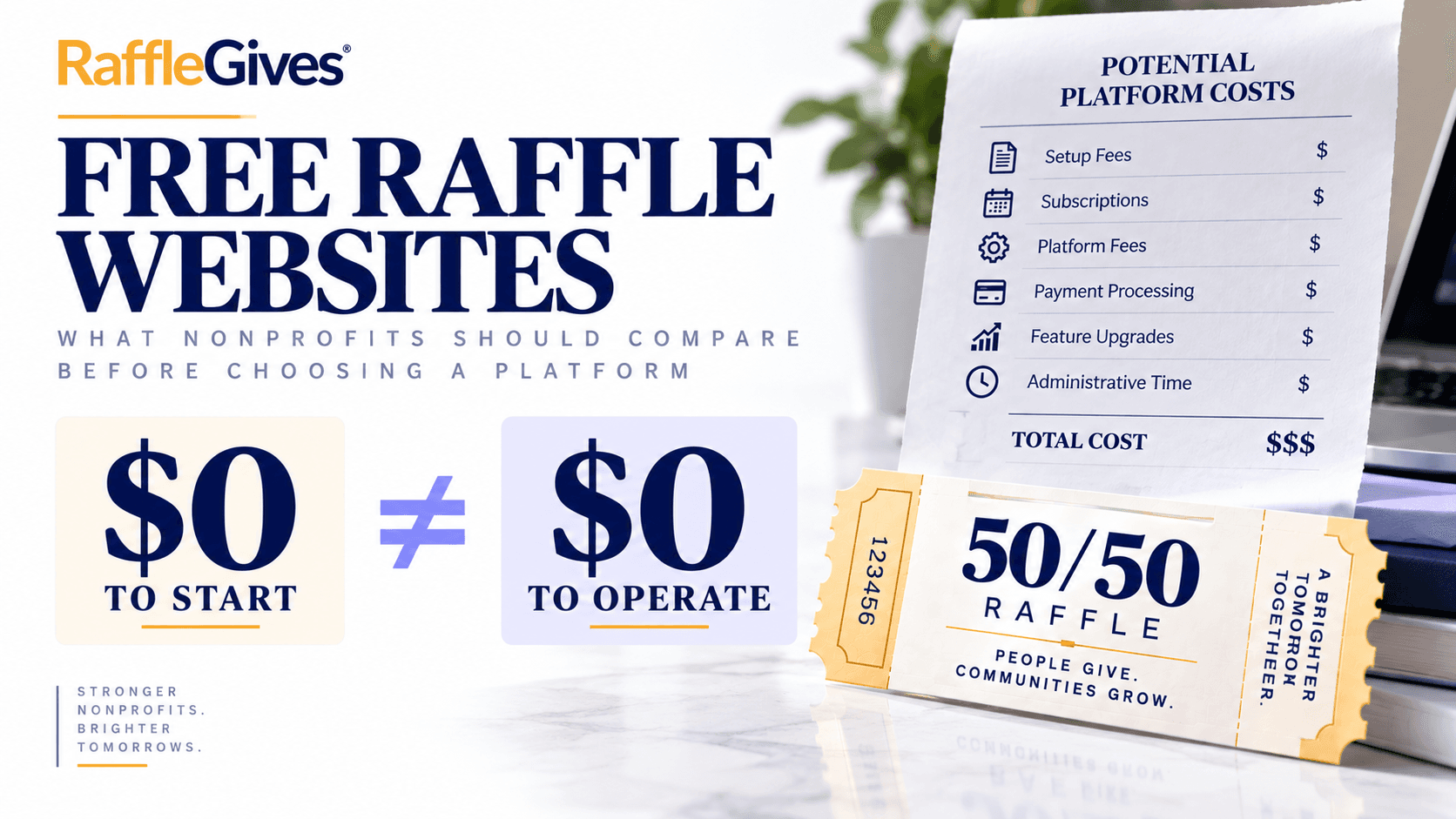
One platform may be free to create an account but charge a percentage of every transaction. Another may offer a free tier while reserving important features for paid plans. Some charge monthly subscriptions, payment-processing fees, setup costs, or additional fees for features a nonprofit may eventually need.
There is also another cost that is easy to overlook: the time required to actually operate the fundraiser.
Before choosing a free raffle website, nonprofits should understand what they are getting, what they will eventually pay, and whether the platform was actually designed to support nonprofit raffle fundraising.
Quick Answer: Are There Free Raffle Websites for Nonprofits?
Yes, but nonprofits should look carefully at what “free” means before choosing an online raffle platform.
Some platforms have no account or setup fee but charge based on ticket sales. Others use monthly subscriptions, annual contracts, payment-processing fees, feature upgrades, or combinations of several pricing models.
A platform that costs nothing upfront is not necessarily free once the campaign begins. At the same time, paying nothing for the software does not automatically make it the least expensive fundraising option.
Nonprofits should compare the total cost of running the raffle, including software fees, payment processing, administrative time, required features, campaign management, and compliance capabilities.
The better question is not simply:
“Which raffle website is free?”
It is:
“Which raffle platform gives our nonprofit the best combination of cost, functionality, simplicity, and fundraising potential?”
What Does “Free Raffle Website” Actually Mean?
The word “free” is powerful in software marketing because it reduces the perceived risk of trying something new.
Unfortunately, it can also be vague.
A platform can legitimately advertise free registration while charging transaction fees once money begins moving through the system. Another may provide free basic functionality but charge for branding, reporting, integrations, payment features, or additional users.
Neither model is inherently bad.
The problem occurs when a nonprofit evaluates fundraising software based only on the first number it sees.
Before selecting a platform, organizations should determine when they pay, why they pay, and what they receive in return.
What Costs Should Nonprofits Compare?
The easiest way to evaluate raffle software is to look beyond the advertised starting price and examine the entire campaign.
Cost to Evaluate | Why It Matters |
|---|---|
Account or setup fee | Determines what the organization pays before fundraising begins |
Monthly subscription | Creates expenses even when no raffle is active |
Annual contract | Can create a long-term financial commitment |
Platform fee | May increase based on campaign sales |
Payment processing | Usually applies to online financial transactions |
Feature upgrades | Important tools may require higher-priced plans |
Branding fees | Some platforms charge to remove their branding or add yours |
User or administrator fees | Additional team members may increase costs |
Reporting tools | Advanced reporting may be limited to paid plans |
Compliance capabilities | Generic tools may not support regulated raffle requirements |
Administrative labor | Manual processes consume staff and volunteer time |
A nonprofit does not necessarily need to avoid every fee on this list.
It needs to understand them.
Transparent pricing makes it easier to determine whether the technology makes financial sense before the campaign begins.
Is a Free Raffle Website Actually the Cheapest Option?
Not always.
Imagine a nonprofit finds a completely free tool that can randomly select a winner. That may solve one small part of the raffle process, but the organization may still need another system to collect payments, a spreadsheet to track participants, a method for assigning tickets, a tool for sending receipts, a process for reconciling purchases, and a separate system for campaign reporting.
Staff or volunteers then have to connect those pieces.
The software may cost $0.
The fundraiser does not.
Administrative labor has a real cost, even when volunteers perform some of that work. Every hour spent reconciling spreadsheets, matching payments, tracking tickets, responding to purchase questions, or preparing a drawing is an hour that cannot be spent promoting the fundraiser or advancing the organization's mission.
That is why total operating cost matters more than software price alone.
What's the Difference Between Free Raffle Tools and Raffle Platforms?
This distinction matters.
A raffle tool might solve one individual task. It could generate random numbers, choose a winner, create tickets, collect names, or display a prize.
A raffle platform is designed to support much more of the fundraising process.
For a nonprofit conducting a digital raffle, that can include campaign creation, ticket pricing, online purchases, payment processing, participant records, ticket tracking, automated receipts, reporting, campaign sharing, winner selection, and campaign administration.
Purpose-built platforms can also account for the fact that charitable raffles are regulated activities.
That becomes increasingly important as a nonprofit moves from a small manual raffle into larger digital fundraising campaigns.
Why Does Compliance Matter When Choosing Raffle Software?
A raffle is not simply another online transaction.
Charitable raffle laws vary substantially across the United States. A state may allow nonprofits to conduct raffles while restricting online ticket sales. Another may permit internet sales but regulate payment methods, purchaser location, licensing, technology providers, drawing procedures, or cash prizes.
Some jurisdictions permit online cash and 50/50 raffles. Others do not.
That means the fact that software can sell a digital ticket does not necessarily mean a nonprofit may legally use it that way.
A generic e-commerce tool may be capable of accepting money and generating a confirmation. That does not automatically make it appropriate for a regulated charitable raffle.
Nonprofits evaluating raffle platforms should therefore ask whether compliance has influenced the way the product was built.
RaffleGives maintains an expanding State Raffle Laws library to help nonprofit leaders understand how those requirements differ across jurisdictions.
Can a Nonprofit Just Use a Free Giveaway Website?
A giveaway and a charitable raffle are not necessarily the same thing.
A giveaway tool may be excellent at collecting entries, running a promotion, or selecting a random winner. That does not mean it was designed to conduct a nonprofit raffle involving paid ticket entries and a regulated prize.
This distinction becomes particularly important with cash and 50/50 raffles.
In a 50/50 raffle, ticket purchases contribute to a pool from which a cash prize is determined according to the campaign structure and applicable rules. That creates requirements and operational needs that a basic giveaway tool may never have been designed to handle.
Nonprofits should choose technology based on the fundraiser they are actually conducting rather than the fact that two products both use the word “raffle.”
What Features Should a Nonprofit Raffle Website Include?
A low price becomes less attractive if the platform cannot do what the organization needs.
For most nonprofits considering digital raffle fundraising, the essential capabilities begin with a simple supporter experience. Participants should be able to understand the fundraiser, choose their ticket package, complete their purchase, and receive confirmation without unnecessary friction.
Administrators need a different set of tools.
They should be able to create and manage campaigns, customize ticket pricing, monitor ticket sales, access participant information, review campaign performance, and complete the raffle without rebuilding the entire transaction history manually.
Useful features can include:
- Mobile-friendly raffle pages
- Custom ticket pricing
- Secure payment processing
- Automated ticket tracking
- Automated purchase receipts
- Real-time campaign reporting
- QR-code sharing
- Social sharing
- Supporter or Ambassador tracking
- Automated winner selection
- Winner communication tools
- Organizational branding
- Administrative review
- Compliance-oriented platform controls
The question is not how many features appear on a software comparison chart.
It is whether the features reduce the amount of work required to run the fundraiser.
Why Does Mobile-Friendly Fundraising Matter?
Supporters increasingly encounter nonprofit campaigns on their phones.
They may see a raffle in a Facebook post, receive a link by text message, scan a QR code at an event, open an email, or receive a campaign link from a friend.
Every additional step creates an opportunity to lose that participant.
A raffle website should therefore be designed around a straightforward mobile experience rather than forcing supporters through a desktop-oriented purchasing process.
This also affects campaign distribution.
If supporters can easily open and share a raffle from their phones, the campaign can move through family, workplace, school, sports, church, and community networks much more naturally.
The technology should make participation easier, not become another obstacle between the nonprofit and the supporter.
Can Raffle Software Help Reach People Outside a Nonprofit's Donor List?
This is one of the biggest opportunities in digital raffle fundraising.
Most nonprofits already have a network much larger than their formal donor database.
Board members have professional networks. Volunteers have friends and coworkers. Parents have extended families. Coaches know former players. Alumni know other alumni. Local businesses have customers and employees.
Traditional fundraising frequently begins and ends with the people the organization already knows how to contact.
A shareable digital raffle can move beyond that immediate list.
When supporters distribute a campaign through their own networks, they introduce the nonprofit to people the organization may never have reached directly.
That makes the ability to share and track campaign distribution an important feature when comparing raffle platforms.

What Is an Ambassador Program?
An Ambassador Program turns existing supporters into campaign distributors.
Instead of relying exclusively on the nonprofit's social accounts or email database, the organization can give individual supporters, teams, families, chapters, volunteers, or community partners tools for sharing the fundraiser with their own networks.
RaffleGives, for example, allows organizations to create unique shareable links and QR codes for Ambassadors and groups.
That gives the nonprofit greater visibility into where campaign participation is coming from while giving supporters a simple way to help.
For schools and youth organizations, Ambassadors might include families, classrooms, teams, coaches, or parent groups. For traditional nonprofits, they might include board members, volunteers, employees, alumni, or business partners.
The fundraiser becomes less dependent on one person repeatedly posting the same link.
Instead, distribution becomes part of the fundraising strategy.
Should Nonprofits Pay a Monthly Fee for Raffle Software?
That depends on how frequently the organization uses the software and what the subscription includes.
A monthly or annual subscription can make sense when an organization continuously uses a large fundraising suite with many different functions.
Raffles are often different.
A nonprofit might run a campaign for several weeks, finish it, and then wait months before conducting another. Paying a recurring subscription during periods when the organization is not actively using the raffle platform may provide little value.
For those organizations, performance-based pricing can make more sense.
Instead of paying for access every month, the platform earns its fee when the organization actually generates raffle ticket sales.
Neither model is automatically superior for every organization.
The nonprofit should match the pricing structure to how it actually fundraises.
What Is Performance-Based Raffle Pricing?
Performance-based pricing ties the platform's fee to fundraising activity rather than simply charging for access to the software.
That changes when the nonprofit assumes financial risk.
Under a traditional subscription model, the organization may pay before it knows whether anyone will participate in the campaign.
Under a performance-based model, the platform cost increases as ticket sales increase.
For organizations experimenting with digital raffles for the first time, that can reduce the upfront barrier to entry.
It also makes the economics easier to model.
If the nonprofit knows the platform percentage, payment-processing costs, prize structure, and other campaign expenses, it can estimate how different ticket-sales levels affect net fundraising revenue.
How Does RaffleGives Pricing Work?
RaffleGives takes a performance-based approach.
There is no cost to create an account, no monthly subscription, no upfront platform fee, and no long-term software commitment.
RaffleGives charges an 8% platform fee based on gross ticket sales.
Payment-processing charges through Stripe apply separately according to the organization's applicable Stripe terms.
That means RaffleGives should not be described as completely free.
A more accurate description is:
Free to start. No monthly subscription. Performance-based pricing.
If the organization does not generate ticket sales, there is no RaffleGives percentage fee on sales that never occurred.
If the campaign succeeds, the platform participates economically in that success.

How Does RaffleGives Work?
RaffleGives was built specifically for nonprofit cash and 50/50 raffle fundraising where those campaign structures are permitted by applicable law.
The process begins with free account creation. The nonprofit establishes its organization profile, provides the required information, and connects its own Stripe account.
From there, the organization creates its raffle, chooses its ticket pricing, uploads campaign content and branding, sets campaign dates, and prepares the fundraiser for administrative review.
After approval, the campaign can go live.
RaffleGives then provides the digital infrastructure supporting ticket purchases, ticket tracking, automated receipts, reporting, sharing, winner workflows, and other campaign functions.
In straightforward jurisdictions, standard campaigns can be ready to launch in as little as 48 hours after the required setup and review are completed. States with additional charitable gaming requirements may require significantly more advance planning.
Does RaffleGives Hold the Nonprofit's Money?
No.
Each organization connects its own Stripe account during setup. Ticket payments are processed through that account, and funds become available according to Stripe's applicable payout schedule.
RaffleGives does not need to hold the nonprofit's raffle proceeds until the campaign concludes.
That gives the organization direct visibility into its payment activity and makes the financial structure easier for leadership to understand.
When comparing platforms, nonprofits should always ask who processes the payment, where the money goes, when the organization receives it, and which fees are deducted along the way.
Those questions matter just as much as the advertised software price.
What Does RaffleGives Automate?
The value of raffle software is not simply the ability to put a ticket online.
It is the amount of administrative work the platform can remove from the organization.
RaffleGives supports digital ticket tracking, automated purchase receipts, real-time sales information, campaign reporting, QR and social sharing, Ambassador distribution, winner selection, and winner communication workflows.
That can replace several manual processes traditionally handled through paper tickets, cash, spreadsheets, email, and volunteer reconciliation.
The nonprofit still needs to promote its campaign.
Technology cannot manufacture community engagement.
What it can do is give staff and volunteers more time to create that engagement instead of spending those hours administering tickets.
Free Software vs. Lower Administrative Burden
This is where the meaning of cost becomes more complicated.
Suppose one platform costs nothing but requires ten additional hours of administrative work. Another charges a campaign fee but automates much of that work.
Which one is cheaper?
The answer depends on the organization.
A volunteer-led group might consider volunteer time plentiful and software budget scarce. A nonprofit with paid staff may calculate the economics very differently.
Neither organization should automatically choose the product with the lowest advertised price.
They should choose the model that creates the best net fundraising result for the resources available to them.
How Should a Nonprofit Compare Raffle Platforms?
Start with the fundraiser rather than the software.
Determine what type of raffle the organization wants to conduct, how much it hopes to raise, who will participate, how tickets will be promoted, and what legal requirements apply.
Then evaluate the technology.
A useful comparison should answer these questions:
- What will we pay before the raffle begins?
- What will we pay if the raffle succeeds?
- Are payment-processing fees separate?
- Do we have to sign a contract?
- Can we stop using the software without continuing subscription costs?
- Does the platform support the type of raffle we want to run?
- Can supporters easily participate from mobile devices?
- Can our community help distribute the campaign?
- Can we see campaign performance while the raffle is running?
- What administrative tasks does the platform automate?
- How are winners selected and notified?
- How does the platform approach state raffle compliance?
- Where do ticket-sale proceeds go?
- How quickly can we launch?
- What happens when we need help?
The answers reveal much more than the word “free.”
Are Free Raffle Websites Good for Schools and Youth Organizations?
They can be, depending on the organization's needs and applicable law.
Schools, PTAs, PTOs, booster clubs, youth sports teams, scouting organizations, and similar groups often operate with limited fundraising budgets. Avoiding large software subscriptions can therefore be particularly attractive.
These organizations also tend to have something extremely valuable: large existing networks.
Parents, grandparents, relatives, coaches, teachers, volunteers, alumni, coworkers, neighbors, and local businesses can dramatically expand a campaign's reach when the fundraiser is easy to share.
For youth organizations, platform selection should therefore consider distribution as much as price.
A tool that costs slightly less but gives families no effective way to help expand the campaign may ultimately generate less net fundraising revenue.
Learn more about raffle fundraising for youth organizations.
Are Online Raffles Legal Everywhere?
No.
This is one of the most important things to understand before choosing any online raffle platform.
Raffle laws are established primarily at the state level, and the rules vary considerably. Some states provide workable frameworks for online cash and 50/50 raffles, while others restrict internet sales, cash prizes, electronic payments, or other parts of the digital raffle model.
Organizations may also face registration, licensing, reporting, local authorization, or campaign-specific requirements.
That means software selection should never begin with the assumption that a feature is legal simply because the platform makes it technically possible.
Before launching a campaign, nonprofits should understand the requirements that apply to their organization and jurisdiction.
Start with the RaffleGives State Raffle Laws resource library and confirm applicable requirements with the relevant regulator or qualified counsel when necessary.
What Should “Free” Mean to a Nonprofit?
For nonprofit leaders, the goal should not be finding software that can put the word FREE in the largest font.
The goal is minimizing unnecessary financial risk while maximizing fundraising capability.
That may mean choosing software with no upfront fee. It may mean avoiding a recurring subscription. It may mean selecting performance-based pricing so technology costs scale with fundraising results.
It can also mean paying for automation that saves dozens of administrative hours.
The right definition of “free” is therefore different for every organization.
But every nonprofit should demand the same thing:
Clear pricing before the campaign begins.
Frequently Asked Questions About Free Raffle Websites
Are there free raffle websites for nonprofits?
Yes. Some raffle tools and platforms offer free accounts, free tiers, or no upfront software costs. Organizations should examine transaction fees, subscriptions, payment-processing charges, feature limitations, and administrative requirements before comparing total cost.
Is there a completely free online raffle platform?
Some basic tools may provide raffle-related functionality at no cost, but nonprofits conducting paid charitable raffles generally need more than a random winner generator or giveaway tool. Payment processing, ticket management, reporting, compliance, and campaign administration can introduce costs even when the underlying software is free.
Is RaffleGives free?
RaffleGives is free to start, but it is not completely free. There is no account-registration fee, monthly subscription, upfront platform fee, or long-term software commitment. RaffleGives charges an 8% platform fee based on gross ticket sales, while applicable Stripe payment-processing fees are separate.
Does RaffleGives charge a monthly fee?
No. RaffleGives does not charge a monthly platform subscription.
Does RaffleGives require a long-term contract?
No long-term software commitment is required for organizations simply to maintain access to the platform.
What is the difference between a raffle website and a giveaway website?
Giveaway websites are often designed for promotional contests or free entries. Nonprofit raffle platforms are designed to support paid charitable raffle fundraising, which can involve different payment, ticketing, reporting, drawing, and legal requirements.
Can a nonprofit use a random winner generator for a raffle?
A random winner generator may perform the drawing function, but it does not necessarily handle ticket sales, payments, participant records, receipts, reporting, or regulatory requirements. Organizations should evaluate the complete raffle process rather than winner selection alone.
What is the cheapest raffle platform for nonprofits?
The answer depends on campaign size, pricing model, payment-processing costs, required features, and the administrative work the nonprofit must perform. Comparing total campaign cost is more useful than comparing only signup prices.
Can nonprofits run 50/50 raffles online?
In some jurisdictions, yes. Other states restrict online raffle ticket sales, cash prizes, or other aspects of digital 50/50 raffles. Organizations should verify applicable state and local requirements before launching a campaign.
What should nonprofits look for in online raffle software?
Important considerations include transparent pricing, mobile usability, ticket management, payment processing, automated receipts, reporting, campaign sharing, supporter distribution tools, winner workflows, administrative efficiency, and compliance capabilities.
Related Reading
If your organization is actively comparing platforms, read our complete guide to the RaffleGives Online Raffle Platform.
Explore more articles about Software & Platform.
Learn how organizations can strengthen campaigns through Fundraising Strategy.
Explore Marketing & Growth strategies for reaching more supporters.
Review our growing State Raffle Laws library before planning an online campaign.
Free to Start Is Different From Free Forever
Nonprofits should be skeptical of any software decision based entirely on the word “free.”
The cheapest tool is not necessarily the one with the lowest signup price. It is the one that helps the organization generate the strongest fundraising result after accounting for technology costs, payment processing, administrative work, campaign functionality, and the resources required to operate the fundraiser.
For some organizations, that may be a free tool and a largely manual process.
For others, a purpose-built platform with performance-based pricing can make more sense.
RaffleGives was built around the second model.
There is no monthly subscription, no upfront platform fee, and no long-term software commitment. Organizations can create their account, connect Stripe, build their raffle, and use purpose-built technology to manage digital raffle fundraising where permitted by law.
RaffleGives charges an 8% platform fee when ticket sales occur.
That is why we describe the platform simply:
Free to start. Performance-based as you raise.
Ready to Explore RaffleGives?
See how the RaffleGives online raffle platform works and decide whether it fits your organization's fundraising strategy.
Get Started Free
See How It Works
https://www.rafflegives.com/how-it-works
View Pricing
https://www.rafflegives.com/pricing
Raffle laws and requirements vary by jurisdiction. RaffleGives content is provided for general informational purposes and does not constitute legal advice. Organizations remain responsible for complying with the laws and regulations applicable to their raffles.