How Youth Organizations Maximize Ticket Sales by Harnessing the Power of the Crowd
Youth organizations like schools, scouting groups, and youth sports consistently outperform traditional fundraising by mobilizing families and communities. Learn how crowd-powered fundraising drives higher ticket sales.
Introduction
Across the nonprofit sector, few organizations are as consistently successful at maximizing ticket sales as youth-focused groups. Schools, Scouting America councils, Girl Scouts, and youth sports leagues raise millions each year, often without relying on major donors or traditional fundraising staff.
Their success is not driven by sophisticated marketing tactics or expansive donor databases. It is driven by people.
Youth organizations are built around active participation. Families, members, and volunteers are not passive supporters. They are embedded in the mission. When fundraising taps into that structure, ticket sales grow naturally and sustainably.
Understanding how these organizations harness the power of the crowd provides a blueprint for any nonprofit seeking to increase participation and expand beyond traditional donor models.
Why Youth Organizations Consistently Outperform Traditional Fundraising Models
Youth organizations operate within a fundamentally different fundraising environment. Unlike many nonprofits that rely heavily on recurring donors or annual appeals, youth organizations mobilize entire communities.
Parents support school fundraisers because their children are directly involved. Families participate in scouting fundraisers because they see them as part of character development and responsibility. Youth sports families engage because fundraising often offsets registration fees, travel costs, or equipment expenses.
This creates a shared incentive structure that transforms fundraising from an obligation into a collective effort. According to the Chronicle of Philanthropy, campaigns that involve peer-driven outreach consistently outperform those relying solely on institutional appeals because trust travels through personal relationships.
How Distributed Fundraising Expands Ticket Sales Beyond Donor Lists
Traditional donor lists are finite and increasingly saturated. Distributed fundraising works differently by extending reach through personal networks.
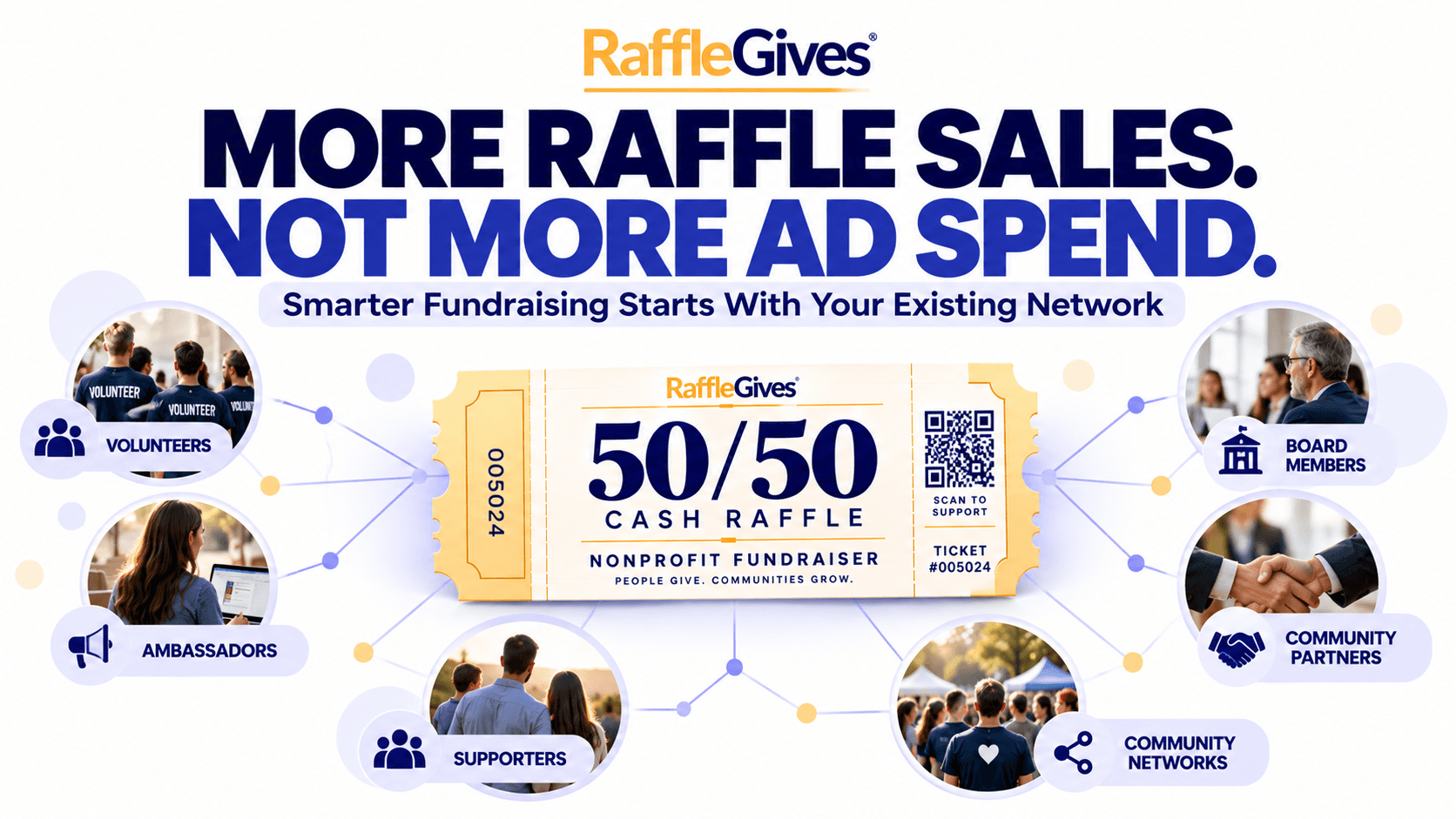
When families, volunteers, and members are empowered to sell or share tickets, the audience expands exponentially. Each participant reaches people the organization may never have contacted directly. Friends, coworkers, extended family members, and neighbors become supporters not because they were targeted by a campaign, but because they were invited by someone they trust.
Research from the Fundraising Effectiveness Project highlights that donor acquisition through peer connections remains one of the most effective ways to reach new supporters, particularly among younger and first-time donors.
This dynamic is what allows youth organizations to consistently outperform more centralized fundraising models.
Real-World Examples of Crowd-Powered Ticket Sales in Youth Organizations
Schools and PTAs
Schools and parent-teacher associations have long relied on families to drive fundraising success. Rather than asking a development office to carry the burden, schools empower students and parents to share fundraisers across classrooms, workplaces, and community groups.
The National PTA emphasizes that family engagement is directly tied to fundraising outcomes, particularly when campaigns are simple, time-bound, and easy to explain.
Scouting Organizations
Scouting America and Girl Scouts are widely recognized as leaders in youth fundraising. Programs like popcorn sales and cookie sales demonstrate how structured participation combined with family support can scale revenue nationwide.
According to Girl Scouts of the USA, these programs are designed not only to raise funds but to teach goal setting, communication, and responsibility, which naturally encourages participation from families and local communities.
Ticket-based fundraising follows the same principles. When scouts are given clear goals and easy ways to share, participation spreads quickly through trusted networks.
Youth Sports Organizations
Youth sports leagues increasingly rely on fundraising to offset rising costs. The Aspen Institute’s Project Play has documented how community-based fundraising helps reduce financial barriers to participation while strengthening local engagement.
When families understand that fundraising directly supports their team and reduces financial pressure, participation becomes a shared priority rather than an administrative task.
Why Families Are the Most Powerful Ticket-Sales Channel
Families represent far more than a single donation opportunity. Each family connects an organization to multiple social and professional circles. These networks are dynamic and constantly evolving, unlike static donor lists.
People are far more likely to purchase a ticket when the request comes from someone they know personally. This aligns with findings from Network for Good, which consistently reports higher engagement rates for peer-shared campaigns compared to organization-led appeals.
Trust, not messaging volume, is what drives ticket sales.
How Digital Tools Strengthen Crowd-Based Fundraising
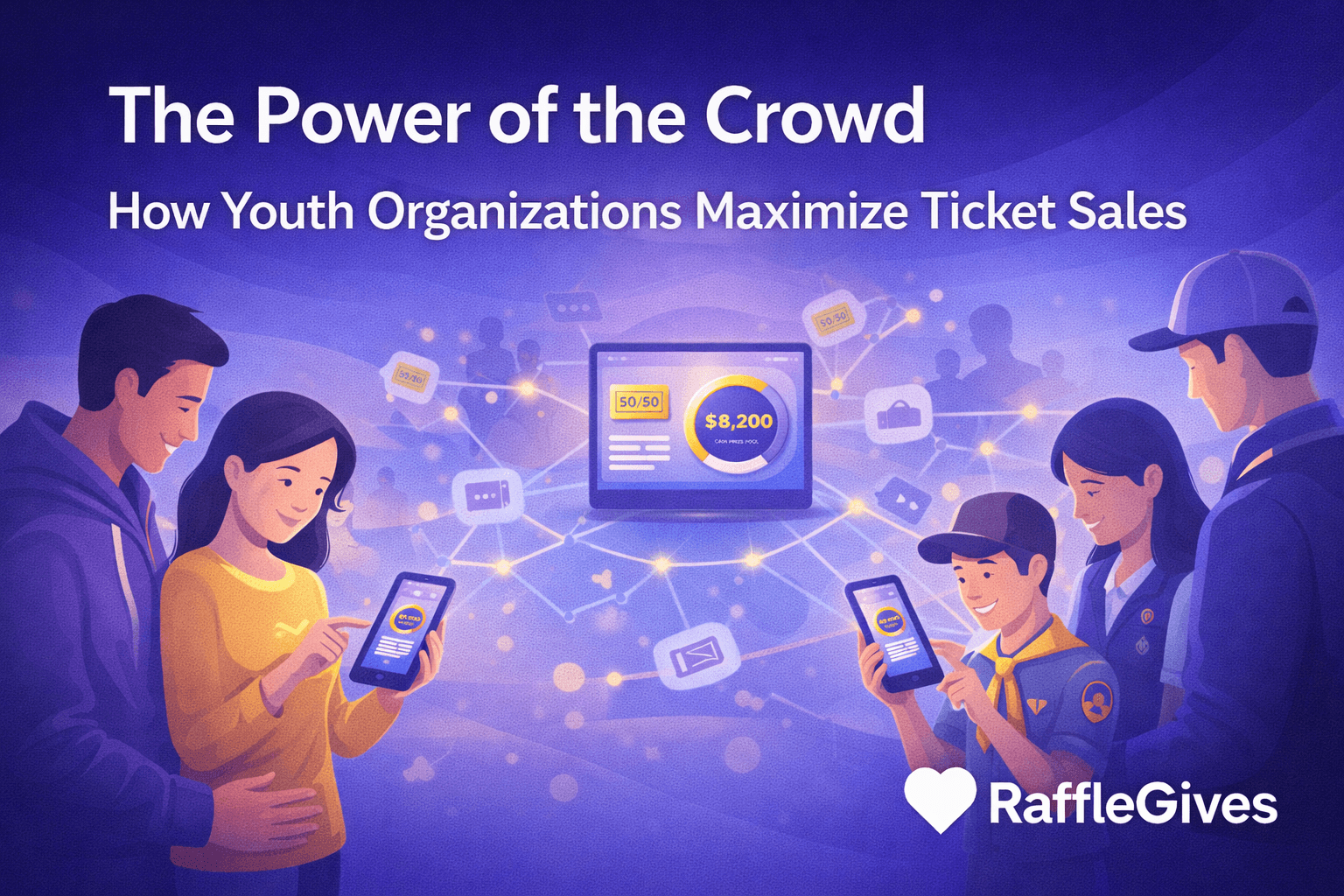
Digital fundraising tools have amplified the effectiveness of distributed fundraising. Instead of relying on physical ticket books or manual tracking, organizations can provide participants with simple links or QR codes that are easy to share and easy to use.
This reduces friction for families and supporters while giving organizations real-time insight into performance. The Nonprofit Times has repeatedly noted that digital fundraising tools improve participation rates by simplifying both promotion and purchase.
Digital access turns community enthusiasm into measurable results.
Why Online Raffles Align Naturally With Youth Organizations
Online raffles work particularly well for youth organizations because they mirror how these groups already operate. They are straightforward, transparent, and require minimal explanation.
Supporters understand immediately how participation works and how it benefits the organization. There is no inventory to manage, no event to attend, and no complex decision-making involved. This simplicity allows families and members to focus on sharing rather than selling, which is a key factor in scaling ticket sales.
How RaffleGives Supports Crowd-Powered Ticket Sales
RaffleGives was built to support organizations that rely on community participation rather than centralized fundraising teams. By focusing exclusively on online cash raffles and 50/50 raffles, the platform removes logistical barriers that often slow down ticket-based fundraising.
For youth organizations, this means families and members can participate confidently, knowing the process is simple, transparent, and easy to explain. RaffleGives complements existing fundraising efforts by providing a digital tool that aligns with how communities already engage.
What Other Nonprofits Can Learn From Youth Organizations
The success of youth organizations offers a powerful lesson. Fundraising works best when it becomes a shared experience rather than a top-down request.
Nonprofits that want to maximize ticket sales can apply these principles by empowering their communities, simplifying participation, and embracing digital tools that support organic sharing. The power of the crowd is not about asking more from the same donors. It is about inviting more people to participate in meaningful ways.
Final Thoughts
Youth organizations demonstrate that the most effective fundraising does not rely on a small group of donors or staff. It relies on community.
By mobilizing families, members, and networks, these organizations consistently maximize ticket sales and reach supporters far beyond traditional fundraising boundaries. Digital tools and online raffles make this approach even more powerful by reducing friction and increasing accessibility.
For nonprofits looking to grow participation and revenue, the lesson is clear. When people feel connected to the mission and empowered to share, fundraising becomes a collective success.
Related Reading