$617 Billion Giving Paradox: Why Nonprofits Need More Everyday Donors
U.S. charitable giving reached a record $617.2 billion, but major giving remains tied to wealth and markets. Learn why nonprofits need to activate more everyday supporters.
Quick Answer
Americans gave an estimated $617.20 billion to charity in 2025, setting a new record for charitable giving in current dollars. For nonprofit leaders, that is encouraging news. However, the headline does not tell the entire story.
The Giving USA 2026 report found that strong financial markets and rising asset values helped support the increase in charitable giving. Individual giving increased, foundation giving grew, and bequests rose substantially. At the same time, research on household philanthropy continues to show that affluent households give at dramatically higher levels than the general population. That creates an important strategic question for nonprofit executives. If charitable giving becomes increasingly dependent on people whose giving capacity is closely tied to investments, asset values, and financial-market performance, how should organizations engage the much larger population of people who may care deeply about their mission but are unlikely to become traditional major donors?
RaffleGives believes part of the answer is broader participation. Through a play-to-give model, nonprofits can create another way for everyday supporters to financially engage with a cause, share the campaign with others, and potentially become long-term members of the organization's community.
Record Charitable Giving Is Great News, but Nonprofit Leaders Should Look Beneath the Headline
Giving USA 2026 reported that charitable giving in the United States reached an estimated $617.20 billion in 2025. It was the first time annual giving surpassed $600 billion, representing a 5.7% increase in current dollars and a 3.0% increase after adjusting for inflation. Individuals remained by far the largest source of charitable contributions, accounting for approximately $394.2 billion. Foundations contributed another $117.15 billion, while bequests totaled $62.19 billion and corporations contributed $43.67 billion.
Several nonprofit sectors also experienced strong growth. Education, public-society benefit organizations, environmental and animal organizations, human services, health, arts and culture, religion, and international affairs all benefited from higher giving in current dollars. For the nonprofit sector, these numbers deserve to be celebrated. More charitable dollars mean more resources potentially available for programs, scholarships, healthcare, community services, education, religious organizations, youth development, and thousands of other missions.
However, fundraising leaders should also ask an important follow-up question:
What drove the increase?
Strong Financial Markets Helped Drive Strong Charitable Giving
Giving USA's analysis makes clear that financial conditions played an important role in the record year. Strong financial markets increased asset values, which likely supported giving from individuals, foundations, and estates. When investment portfolios rise, businesses appreciate, and households accumulate additional wealth, high-net-worth donors often have more financial flexibility to make larger charitable gifts. That relationship is not surprising. Philanthropy has always been influenced by economic conditions.
An affluent donor who owns appreciated stock may find that a strong market creates an ideal opportunity to make a charitable gift. A foundation whose assets have grown may have additional resources available for grants. Higher estate values can increase charitable bequests. Business owners experiencing strong financial years may also have greater capacity to support the organizations they care about. At the same time, Giving USA noted that consumer sentiment remained weak. Households worried about inflation, housing costs, employment, debt, and everyday expenses may not experience the same sense of financial security as investors benefiting from appreciating assets. That creates a charitable environment where total giving can rise dramatically even while many ordinary households remain cautious.
The Wealth Effect Matters in Philanthropy
Research into affluent household philanthropy reinforces how significant wealthy donors are to the nonprofit sector. The Bank of America Study of Philanthropy found that affluent households that donated in 2024 gave an average of more than $33,000. That was more than ten times the level of giving among the general population. Affluent donors are also increasingly strategic about how they give. Many use donor-advised funds, foundations, planned-giving strategies, appreciated securities, charitable distributions, and formal philanthropic budgets. For organizations with mature development programs, these donors can provide transformational gifts that fund buildings, programs, endowments, scholarships, and major expansion initiatives.
Nonprofits should absolutely continue cultivating those relationships. The strategic issue is not that major donors have become too important. The issue is what happens when an organization becomes too dependent on a relatively narrow portion of its supporter base.
RaffleGives Executive Insight
A diversified fundraising program should not ask whether a nonprofit should pursue major donors or everyday supporters. It should do both.
Major gifts can provide transformational capital. Broad participation can create resilience, community engagement, new donor relationships, and recurring fundraising opportunities. The strongest fundraising strategy is one that does not require every supporter to participate in exactly the same way.
What Happens When Financial Markets Slow Down?
The same forces that help philanthropy during strong financial periods can create pressure when conditions deteriorate. Markets decline. Business cycles change. Liquidity tightens. Interest rates move. Economic confidence falls. Donors become more cautious. A nonprofit has no control over those factors. It cannot determine whether the stock market rises next year. It cannot control whether a major donor's company has a successful exit. It cannot control whether a wealthy supporter experiences a liquidity event or decides that the current year is the right time for a significant charitable contribution.
This does not mean major-gift fundraising is unreliable. It means relying too heavily on any concentrated source of revenue introduces risk. Nonprofits already understand this concept in other areas. Investment portfolios are diversified because concentrating everything in one asset can be dangerous. Organizations seek multiple grants because relying on one foundation can create vulnerability. Businesses diversify customers because losing one major account should not threaten the entire organization. Fundraising deserves the same strategic thinking.
What Does a Diversified Nonprofit Fundraising Model Look Like?
A healthy nonprofit fundraising program can include several complementary revenue channels.
Fundraising Channel | Strategic Role |
Major gifts | Large, transformational contributions from highly committed supporters |
Recurring giving | Predictable monthly or annual donor revenue |
Foundations and grants | Programmatic and institutional funding |
Corporate sponsorships | Business partnerships and community support |
Planned giving | Long-term legacy and estate contributions |
Annual appeals | Traditional donor outreach and renewal |
Events | Community engagement and fundraising |
Peer-to-peer campaigns | Supporter-led audience expansion |
Raffles and play-to-give fundraising | Broad participation and supporter activation |
None of these channels should exist in isolation. A major donor might sponsor a raffle. A corporate partner might contribute a prize. Existing donors may purchase tickets and share the campaign. First-time participants may later become recurring donors or volunteers. The strongest model connects these fundraising channels rather than forcing them to compete with one another.
The Other Side of America's Giving Story
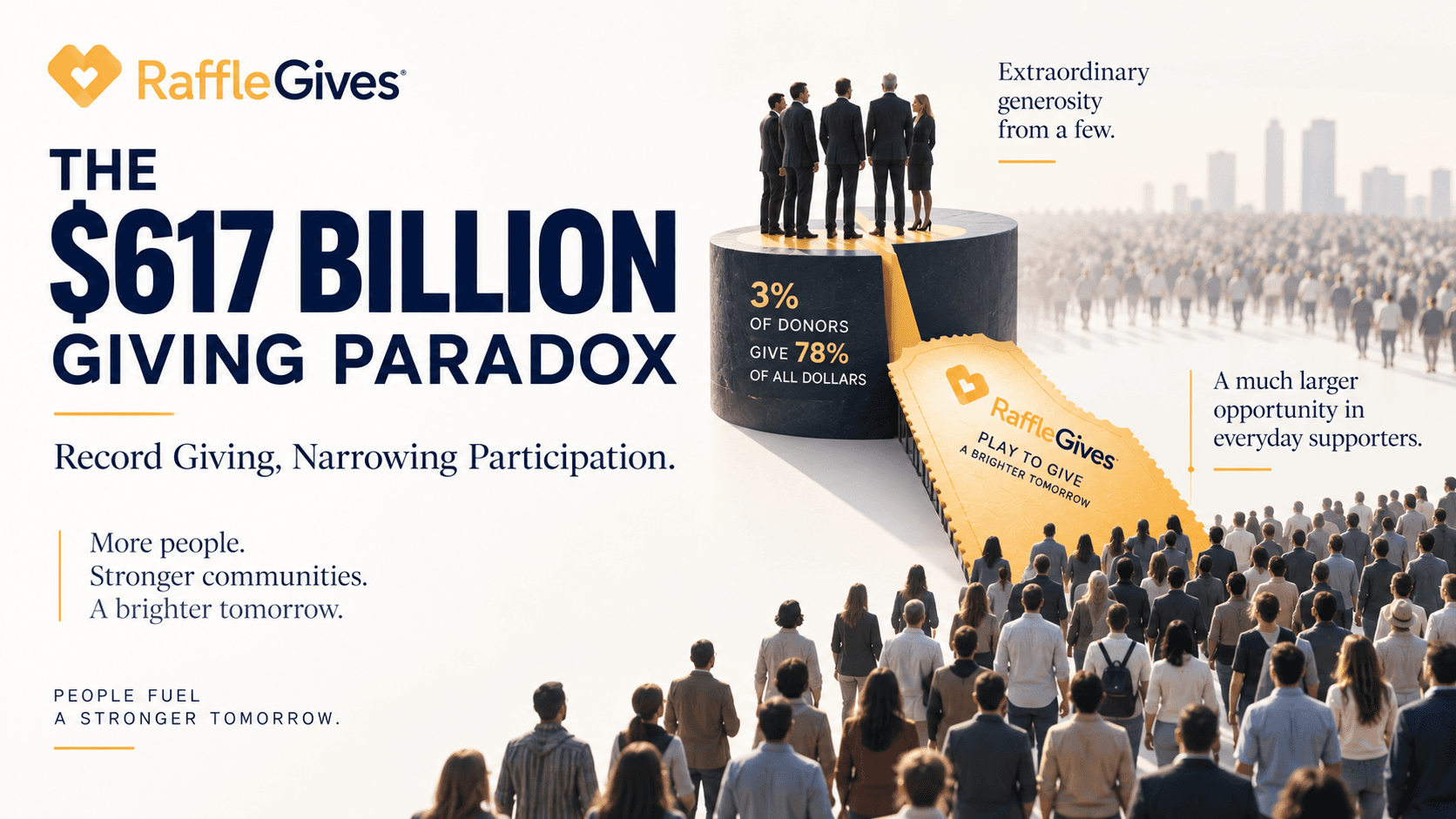
There is another trend nonprofit executives should pay attention to. While total charitable dollars have reached record levels, household participation in philanthropy has been declining over time.
Bank of America research found that 81% of affluent households made charitable contributions in 2024, down from 91% in 2015. Research cited in the same body of work shows that participation among the broader population has also fallen substantially over the longer term. That creates what might be called the giving paradox.
America can generate more charitable dollars than ever before while a smaller share of households actively participate in charitable giving. Those two facts are not contradictory. If donors at the top increase the size of their gifts, aggregate giving can rise even while fewer households are participating. For nonprofit leaders, that raises a much larger question than how to find the next major donor.
How do we bring more people into philanthropy?
Traditional Donation Appeals Do Not Reach Everyone
Most nonprofits rely heavily on a familiar fundraising message: Please donate.
The organization may send the request by email, direct mail, social media, text message, or through an event. The format changes, but the underlying transaction is usually the same. For committed donors, that approach works. For everyone else, it can eventually become repetitive. A supporter may receive one appeal from a school, another from a church, another from a youth organization, another from a local charity, and another from a national cause. Each organization is worthy of support, but the supporter experiences a constant stream of requests for money. This is one of the dynamics behind donor fatigue.
The solution is not to stop asking people to support nonprofit organizations. The opportunity is to create more ways to participate.
From Give to Play-to-Give
Traditional fundraising generally asks one question:
Will you donate?
Play-to-give introduces another:
Would you like to participate in something engaging that also supports the mission?
A charitable raffle changes the nature of the interaction. The supporter still provides financial support to the nonprofit, but the experience includes participation, anticipation, sharing, and the opportunity to win. For people who already feel connected to the organization, this creates a new reason to engage. For someone who does not consider themselves a traditional donor, it may provide a much easier entry point into the nonprofit's community. That difference matters.
A supporter who might ignore another donation request may happily purchase raffle tickets to support their child's school, a local veterans organization, a youth sports team, a church, an animal rescue, or another cause they care about. The mission has not changed. The mechanism for participation has.
Why 50/50 Raffles Can Be Especially Engaging
Where permitted by applicable law, 50/50 raffles create one of the simplest fundraising propositions for supporters to understand. Participants purchase tickets. As participation grows, the prize pool grows. A portion of the applicable pool goes to the winner, while another portion supports the nonprofit organization. That structure creates a natural relationship between fundraising and engagement. The nonprofit benefits when participation increases. The potential winner also benefits when the eligible prize grows. Supporters therefore have a reason not only to participate but also to tell other people about the campaign.
A traditional donation does not normally become more exciting because a friend also donates. A 50/50 raffle can. That sharing dynamic is one reason play-to-give can help organizations reach beyond their existing donor database.
The Biggest Opportunity May Be the People Already Around Your Organization
Consider a nonprofit with 30 major donors and a broader community of 25,000 people. Those 30 major donors may be responsible for a substantial portion of annual fundraising, and the development team should continue building those relationships. But what is the organization's strategy for the other 24,970 people?
They may include parents, grandparents, alumni, former volunteers, event attendees, employees, community members, fans, church members, local business owners, social-media followers, and friends of existing supporters. Most will never become major donors. That does not mean they cannot become valuable supporters. One person may purchase $20 in raffle tickets. Another may participate several times throughout the year. Someone else may share the campaign with twenty coworkers. Another might become a volunteer. A first-time participant may eventually become a recurring donor. This is where broad participation becomes strategically interesting.
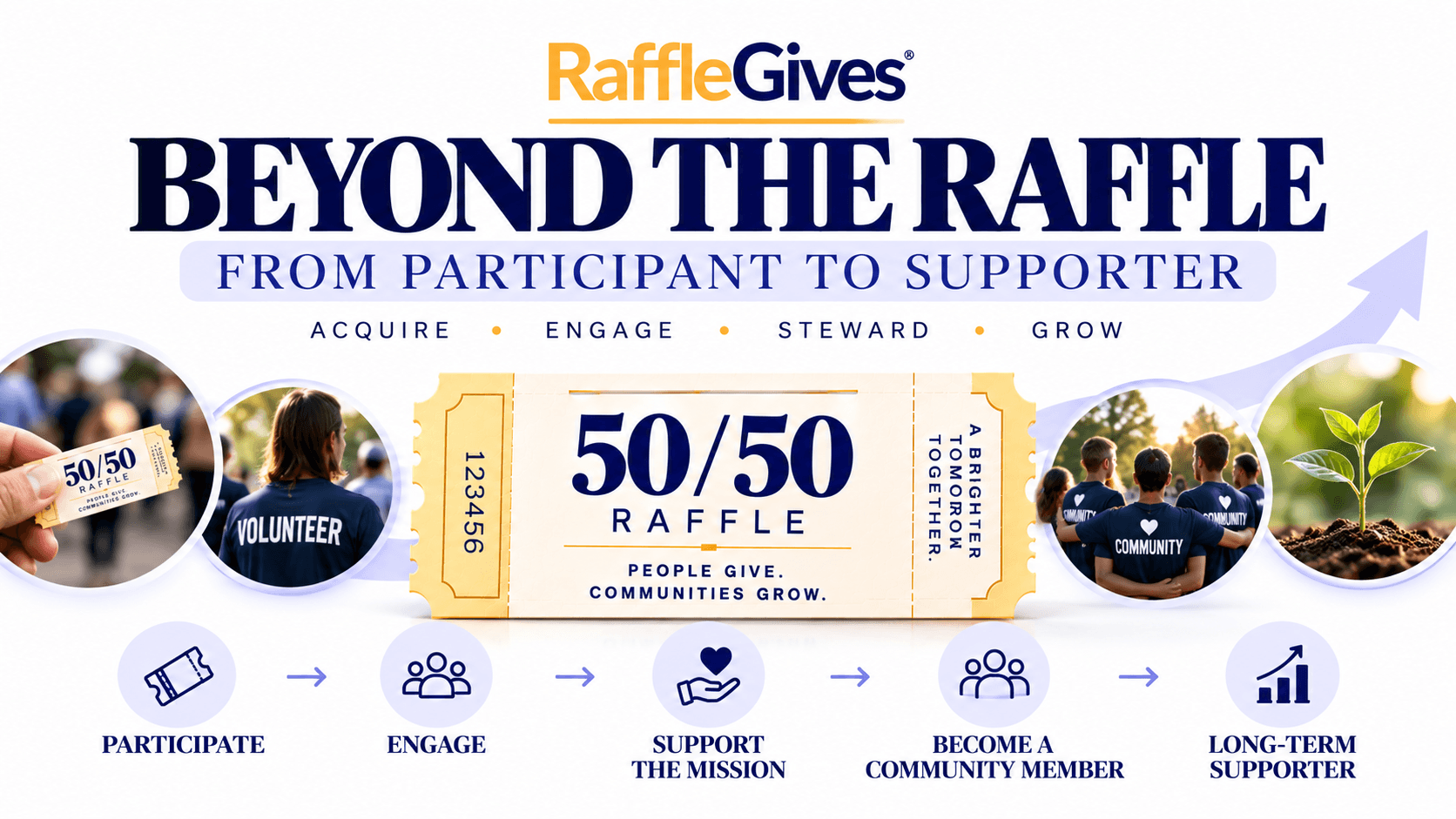
Raffle fundraising is not only about the revenue generated from the initial ticket purchase. It can also create a new relationship.
A Raffle Participant Is More Than a Transaction
When someone participates in a nonprofit raffle, the organization has learned something important. That person was willing to interact with the mission and provide financial support. They may not have filled out a traditional donation form, but they have taken action. A smart nonprofit can build on that engagement. After the raffle, participants can receive an impact update explaining what the fundraiser accomplished. They can be invited to follow the organization, attend an event, volunteer, subscribe to a newsletter, participate in the next campaign, or learn more about the mission.
Over time, some of those individuals may migrate into traditional giving. That means play-to-give can accomplish two objectives simultaneously:
Generate fundraising revenue today while expanding the supporter base for tomorrow.
Why This Matters Even More for Small and Mid-Sized Nonprofits
Large national organizations often have sophisticated development operations. They may employ major-gift officers, donor researchers, planned-giving specialists, institutional fundraising teams, marketing departments, and dedicated technology staff. Small nonprofits rarely have those resources. The executive director may also be responsible for development. One staff member may manage marketing, events, volunteers, and donor communication simultaneously. Board members may be expected to introduce donors and secure sponsorships.
The same group of supporters receives appeal after appeal. For these organizations, expanding the participation base can be particularly valuable. Digital fundraising makes that easier. Rather than manually distributing thousands of paper raffle tickets, organizations can use modern fundraising technology to connect supporters through email, social media, QR codes, websites, events, and community partnerships where online raffle activity is legally permitted.
Technology turns reach into potential scale.
Major Gifts and Play-to-Give Should Work Together
The strongest version of this strategy is not replacing wealthy donors with small-dollar participants. It is connecting both groups to the same mission. Imagine a nonprofit campaign where a major donor or corporate partner helps sponsor the fundraiser. Thousands of supporters participate in the raffle. Volunteers promote it through their networks. Local businesses share the campaign. First-time participants are introduced to the organization. The major donor creates leverage. The broader community creates scale. The organization gains both revenue and new relationships. That is much more powerful than thinking of raffle fundraising as simply selling tickets.
What Should Nonprofit Executives Measure?
Gross revenue matters, but it should not be the only metric used to evaluate a participation-based campaign. A nonprofit that wants to understand the strategic value of play-to-give should also measure broader engagement.
Metric | What It Tells Leadership |
First-time participants | Whether the campaign expanded beyond existing donors |
Percentage of new supporters | How effectively the raffle reached a new audience |
Average purchase | How supporters chose to participate |
Campaign shares | Whether supporters became promoters |
Email-list growth | Whether the fundraiser expanded future communication reach |
Repeat participation | Whether supporters returned for future campaigns |
Referral sources | Which channels generated participation |
Sponsor involvement | Whether the raffle created additional community partnerships |
Volunteer participation | Whether the campaign activated internal advocates |
Later donor conversion | Whether raffle participants became traditional donors |
These metrics help answer the larger strategic question:
Did this fundraiser merely generate revenue, or did it expand our fundraising ecosystem?
What Giving USA 2026 Should Tell Nonprofit Leaders
The $617.20 billion charitable-giving record is genuinely good news. It demonstrates the extraordinary generosity that continues to exist throughout the United States. It also illustrates how strongly economic conditions can influence philanthropy. Strong financial markets helped support individual giving. Higher asset values benefited foundations and estates. At the same time, weaker consumer sentiment likely constrained some households experiencing greater financial uncertainty.Nonprofit executives cannot control those economic forces.
They can control how many different ways people are invited to participate in the mission. That may be one of the most important strategic lessons contained within the Giving USA numbers. The future of nonprofit fundraising does not have to depend solely on identifying more wealthy donors. It can also involve creating a much larger community of everyday supporters.
How RaffleGives Fits Into a Broader Fundraising Strategy
RaffleGives was built around a simple idea: more people should have an engaging and accessible way to participate in charitable fundraising. Our play-to-give model gives qualified nonprofit organizations another tool for reaching supporters who may not respond to a traditional donation request.
Where raffle fundraising is permitted by applicable law, organizations can create digital campaigns that turn participation into fundraising while making the experience simple for supporters and manageable for nonprofit teams. The new RaffleGives platform is completely self-service and automated, reducing much of the administrative work that traditionally accompanies raffle fundraising. Nonprofit organizations can focus more attention on their mission, supporters, and promotion rather than learning complicated fundraising technology.
This is not intended to replace major gifts, grants, corporate partnerships, annual giving, or traditional development programs. It is designed to complement them.
Keep cultivating the major donor. Keep writing grants. Keep building corporate relationships. Keep asking loyal supporters for meaningful gifts. But also ask another question:
Who are we not reaching today?
If thousands of people already care about your organization but have never responded to a traditional fundraising appeal, the problem may not be that they are unwilling to support your mission. They may simply need a different way to participate.
Related Reading
How to Promote an Online 50/50 Raffle
How to Build a 30-Day Marketing Plan for an Online 50/50 Raffle
The Future of Fundraising Is Broader Participation
Record charitable giving should be celebrated, but nonprofit leaders should not confuse record aggregate dollars with a fully engaged donor population.
A resilient development strategy continues cultivating high-net-worth donors while creating more opportunities for everyone else to participate. That is where RaffleGives fits. Play-to-give gives supporters another way to connect with a mission, financially participate, share a campaign, and potentially begin a longer relationship with the organization. For nonprofit executives, the opportunity is larger than another fundraising tool. It is the opportunity to broaden the base of people who believe they have a place in philanthropy.
Learn more about how RaffleGives can help your organization build a modern participation-based fundraising strategy at RaffleGives.com.
Follow RaffleGives for nonprofit fundraising research, strategy, raffle-law updates, and digital fundraising insights: