How to Build a 30-Day Marketing Plan for an Online 50/50 Raffle
Build a successful online 50/50 raffle with this complete 30-day nonprofit marketing plan. Includes daily promotion ideas, email campaigns, social media strategy, volunteer outreach, business partnerships, QR code marketing, and countdown checklists.
Quick Answer
The most successful online 50/50 raffles are rarely the ones with the biggest prizes. They are the ones with the best marketing plan.
Rather than posting occasionally on social media and hoping supporters discover the fundraiser, successful nonprofit organizations build a structured marketing campaign before ticket sales begin. A 30-day marketing plan helps organizations generate awareness, maintain momentum, engage supporters, and maximize ticket sales throughout the life of the raffle.
This guide provides a practical, day-by-day marketing roadmap that nonprofit organizations can follow before, during, and after launching an online 50/50 raffle.
Why Most Online Raffles Never Reach Their Potential
One of the biggest misconceptions in nonprofit fundraising is that a great raffle will naturally attract supporters.
Unfortunately, that rarely happens.
Across nonprofit communities, fundraising leaders consistently describe the same challenge. They spend weeks organizing a raffle, secure an attractive prize, build excitement within their organization, and then discover that ticket sales are slower than expected. After the drawing, many conclude that people simply were not interested.
In reality, the issue is usually much simpler.
Not enough people knew the raffle existed.
Marketing is often the difference between an average fundraiser and an exceptional one. Organizations rarely struggle because they care too little about their mission. They struggle because marketing responsibilities are added to an already full workload. Executive directors are managing programs. Development staff are cultivating donors. Volunteers have families and careers. Parent leaders are balancing school activities with work commitments. Very few nonprofits have dedicated marketing departments.
That means someone eventually asks:
"What should we post today?"
When there is no answer to that question, marketing becomes inconsistent. Emails are delayed, social media goes quiet, volunteers are unsure what to share, and valuable opportunities to reach new supporters are missed.
A written marketing plan removes that uncertainty. Instead of wondering what to do next, your team follows a proven schedule that keeps the campaign active from the first announcement through the final drawing.
Marketing Is Not an Event. It Is a Process.
Many organizations think about marketing as something that happens after the raffle launches. Successful nonprofits think differently. They recognize that fundraising begins long before the first ticket is sold. Supporters need time to become familiar with the campaign, understand the organization's mission, recognize the value of participating, and share the fundraiser with others. Those actions rarely happen after seeing a single social media post.
Marketing works because of repetition.
Each email, Facebook post, volunteer conversation, QR code, sponsor mention, and community partnership builds awareness. Over time, those touchpoints create momentum that leads to stronger participation.
This is why successful organizations rarely rely on one communication channel. They combine email, social media, websites, community outreach, business partnerships, volunteers, and in-person events into one coordinated campaign.
Before You Build Your Calendar
A marketing calendar only works if the necessary materials already exist.
One of the biggest mistakes nonprofit organizations make is launching a raffle before they have prepared the assets needed to promote it. As a result, volunteers spend the first week designing graphics, writing emails, or searching for photos instead of actually marketing the campaign.
Preparation creates consistency. Before your raffle launches, gather everything your team will need for the next thirty days.
Marketing Asset | Why It Matters |
Campaign landing page | Gives supporters one consistent destination to learn about the raffle and purchase tickets. |
Feature image | Creates a recognizable visual identity across every marketing channel. |
Social media graphics | Allows volunteers to share professional-looking posts immediately. |
Email templates | Keeps communication consistent throughout the campaign. |
QR code | Connects printed materials directly to the raffle page. |
Short campaign URL | Makes sharing easier during presentations and conversations. |
Frequently Asked Questions | Reduces confusion and increases supporter confidence. |
Volunteer toolkit | Gives advocates ready-to-share content instead of asking them to create their own. |
Having these materials prepared before launch allows the organization to focus on engagement rather than content creation.
Assign Marketing Responsibilities Early
A successful campaign is rarely managed by one person. Even small nonprofits benefit from assigning clear responsibilities before launch.
For example, one volunteer may schedule social media posts, while another sends email updates. A board member may coordinate business partnerships, and a parent volunteer may distribute QR code flyers at school events.
When responsibilities are shared, marketing becomes more consistent and less overwhelming.
The goal is not to create more work. The goal is to divide the work into manageable pieces that fit naturally into each person's existing role.
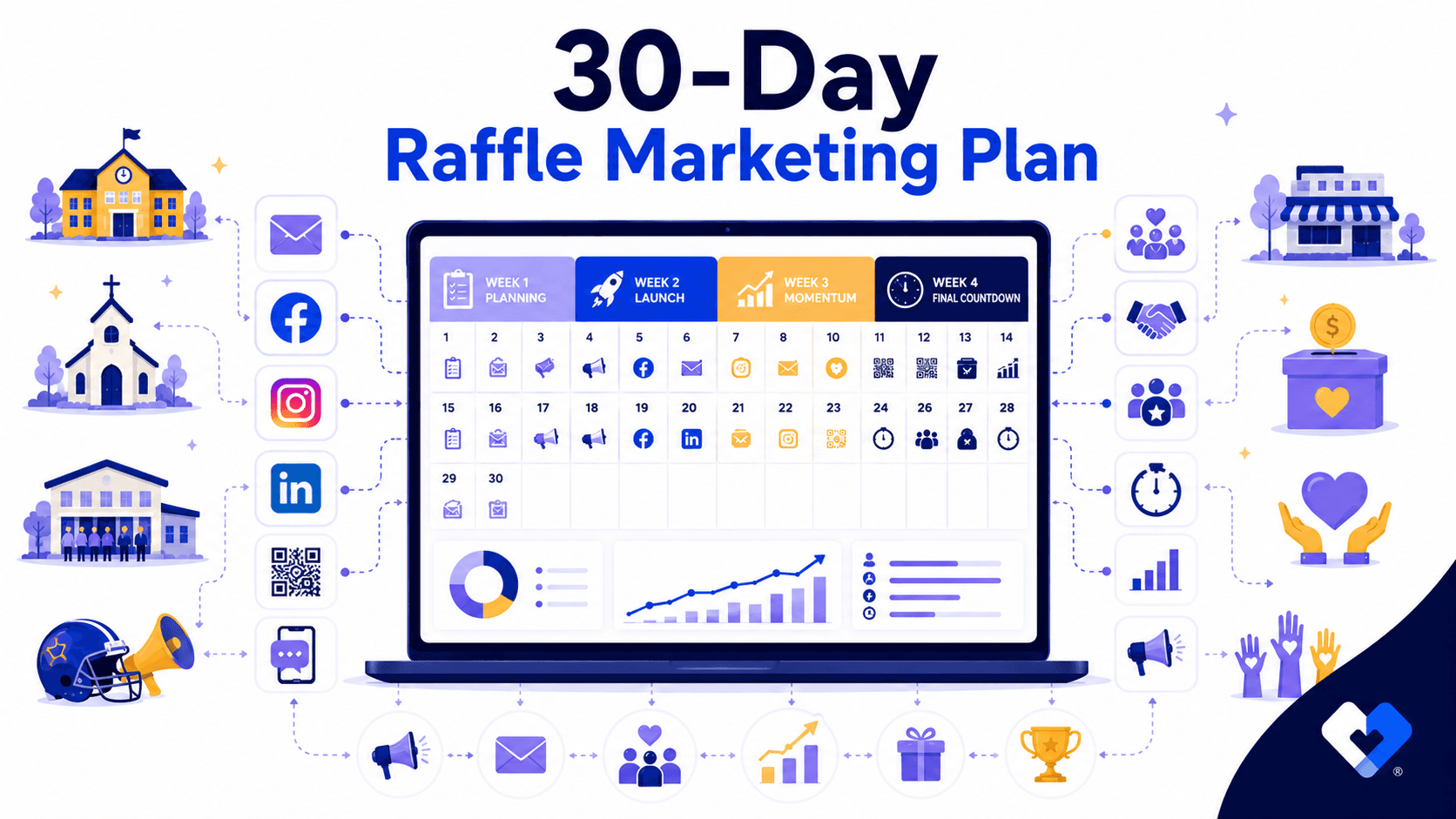
Your 30-Day Marketing Calendar
The following calendar provides a practical roadmap that nonprofit organizations can adapt to almost any online 50/50 raffle campaign.
Rather than focusing only on launch day, this schedule begins one month before the drawing and gradually builds awareness, engagement, and urgency throughout the campaign.
Day | Primary Activity | Objective |
30 | Announce the upcoming raffle | Build awareness and anticipation. |
29 | Publish a "coming soon" social media post | Generate curiosity and early engagement. |
28 | Send your first email announcement | Introduce the campaign and explain the mission. |
27 | Prepare volunteer marketing materials | Equip advocates before ticket sales begin. |
26 | Confirm sponsor participation | Expand community reach. |
25 | Publish your raffle landing page | Create a central destination for supporters. |
24 | Generate QR codes and printed materials | Prepare for in-person promotion. |
Notice that none of these activities involve asking people to purchase tickets immediately. The first week is about building awareness.
Supporters should understand what the fundraiser supports, why it matters, and when the campaign will officially begin.
Creating anticipation before launch gives organizations momentum that many fundraising campaigns never achieve.
Week One Goal: Build Anticipation
The objective during the first week is simple.
Introduce the fundraiser without overwhelming supporters.
Share the story behind the campaign. Explain how proceeds will be used. Highlight the impact every ticket purchase will have on students, athletes, community members, veterans, families, or other beneficiaries.
Avoid making every communication about the prize. People may initially notice the prize, but they participate because they believe in the mission.
When your first week focuses on purpose instead of transactions, every message that follows becomes more meaningful. In the next section, we'll build the launch week strategy, including daily activities for email marketing, Facebook, Instagram, LinkedIn, volunteer outreach, QR code distribution, community partnerships, and the techniques that consistently create early ticket sales and campaign momentum.
Week Two: Launch Your Raffle with Purpose
The second week is where your marketing shifts from building awareness to encouraging participation. This is the official launch of your raffle. While many organizations focus almost exclusively on announcing that tickets are available, successful campaigns recognize that launch week is about much more than making one announcement.
Your objective is to create visibility across every communication channel without overwhelming your supporters. Instead of asking for a sale every day, vary your content by highlighting your mission, showcasing the prize, introducing your volunteers, thanking sponsors, and explaining how every ticket purchase helps your organization.
By the end of launch week, supporters should have seen your raffle multiple times in different places. Repetition builds familiarity, and familiarity builds trust.
Launch Week Marketing Calendar
Day | Primary Activity | Objective |
23 | Official raffle launch | Announce that ticket sales are open. |
22 | Facebook campaign post | Encourage sharing throughout the community. |
21 | Instagram photo or Reel | Showcase the prize and the mission. |
20 | LinkedIn update | Reach professional supporters and local businesses. |
19 | Email reminder | Share progress and thank early participants. |
18 | Volunteer spotlight | Celebrate the people making the fundraiser possible. |
17 | Community outreach | Expand visibility through local partners and organizations. |
Rather than treating each activity as a separate marketing effort, think of them as pieces of one larger story. Each communication reinforces the previous one while introducing the raffle to new audiences.
Email Marketing: Your Highest-Converting Channel
Social media creates awareness, but email consistently remains one of the strongest drivers of nonprofit fundraising participation.
Unlike social media algorithms, your email list consists of people who have already expressed an interest in your organization. They may be previous donors, volunteers, parents, alumni, church members, sponsors, or community supporters.
Launch week should include your first dedicated raffle email.
That email should answer four simple questions:
- Why are you raising money?
- What impact will the funds have?
- What can supporters win?
- How can they participate?
Avoid making the email feel like a sales pitch. Instead, focus on telling a story about the mission your organization serves. When supporters understand the purpose behind the fundraiser, purchasing a raffle ticket becomes a way to participate in that mission.
Facebook: Build Community Momentum
Facebook remains one of the most valuable platforms for nonprofit fundraising because it encourages sharing among families, friends, and local communities.
Instead of posting the same raffle graphic repeatedly, vary your content throughout the week. For example:
Content Type | Purpose |
Launch announcement | Introduce ticket sales. |
Mission story | Explain how proceeds will be used. |
Volunteer spotlight | Humanize the campaign. |
Sponsor recognition | Thank community partners. |
Behind-the-scenes photos | Build authenticity. |
Early progress update | Create excitement and momentum. |
Every post should include a clear call to action and a direct link to your raffle page.
Instagram: Tell the Story Visually
Instagram performs best when organizations focus on authentic, engaging visuals rather than promotional graphics alone. Consider sharing:
- Volunteers preparing for the fundraiser
- Students, athletes, or community members benefiting from the campaign
- Sponsor highlights
- Short videos explaining why the fundraiser matters
- Behind-the-scenes content
- Countdown graphics leading toward the drawing
Reels can be particularly effective because they often receive broader organic reach than static posts. Keep captions conversational and mission-focused. The raffle should feel like an opportunity to support your organization, not simply a chance to win a prize.
LinkedIn: Don't Forget Your Professional Network
Many nonprofit organizations overlook LinkedIn during fundraising campaigns. That is a missed opportunity. Board members, corporate sponsors, alumni, business owners, civic leaders, and community advocates are often active on LinkedIn. These audiences may be more interested in supporting your organization's impact than they are in the prize itself.
Launch week is an excellent time to publish a post discussing:
- your mission
- why the fundraiser matters
- the community impact
- how local businesses can help
Professional audiences frequently become valuable advocates by sharing campaigns with their own networks.
QR Codes Create Offline Opportunities
Not every supporter will discover your raffle online. QR codes allow your in-person marketing to connect seamlessly with your digital campaign. Consider placing QR codes on:
- event signage
- school newsletters
- church bulletins
- booster club programs
- sponsor counters
- restaurant tables
- flyers
- banners
- community bulletin boards
- volunteer handouts
The easier it is for someone to reach your raffle page, the more likely they are to participate.
Activate Your Volunteers
One of the biggest mistakes nonprofit organizations make is assuming volunteers know how to promote the raffle.
Instead of asking them to "share the fundraiser," provide a ready-to-use toolkit. A volunteer toolkit might include:
Resource | Benefit |
Sample Facebook post | Easy sharing without writing copy. |
Sample email | Consistent messaging. |
QR code | Simple offline promotion. |
Campaign graphics | Professional appearance. |
Raffle link | Eliminates confusion. |
Frequently asked questions | Helps volunteers answer supporter questions confidently. |
The easier you make it for volunteers to participate, the more likely they are to become enthusiastic ambassadors for your campaign.
Build Community Partnerships
Launch week is also the perfect time to involve your local community.
Reach out to businesses, community organizations, chambers of commerce, civic groups, and long-time supporters who believe in your mission.
Many businesses are willing to help promote a fundraiser simply because they want to support a local nonprofit. Partnerships do not always require financial sponsorship. Sometimes displaying a flyer, sharing a Facebook post, placing a QR code near a checkout counter, or mentioning the fundraiser in a customer newsletter can significantly expand your reach.
These community relationships often continue long after the raffle has ended, creating opportunities for future fundraising campaigns.
Measure What Is Working
As your raffle enters its second week, begin paying attention to performance. You do not need complex marketing software to identify trends. Monitor simple indicators such as:
Metric | Why It Matters |
Ticket sales | Measures campaign momentum. |
Email open rates | Shows how effectively your messages capture attention. |
Social media engagement | Identifies content supporters enjoy sharing. |
Website traffic | Reveals how people are discovering your raffle. |
QR code scans | Measures offline marketing success. |
Volunteer participation | Indicates how effectively your advocates are engaged. |
These early insights will help shape the remainder of the campaign. In the next section, we'll focus on maintaining momentum during Week Three, creating urgency during the final countdown, announcing the winner professionally, evaluating campaign performance, and providing downloadable-style checklists that organizations can reuse for every future online 50/50 raffle.
Week Three: Maintain Momentum
By the third week, many nonprofit organizations begin to see a slowdown in ticket sales. This is completely normal. The initial excitement of launch week has passed, and the final urgency of the drawing has not yet arrived. This period is often referred to as the "middle slump," and it is where many organizations make one of two mistakes.
Some stop marketing because they assume everyone has already seen the raffle.
Others post the exact same message repeatedly, asking supporters to buy tickets without offering anything new.
Neither approach works well.
Week Three is about keeping your campaign fresh. Instead of simply reminding people that tickets are available, continue telling the story of your organization. Share progress, celebrate milestones, recognize supporters, and give people new reasons to engage with the fundraiser. Remember that many potential participants are seeing your raffle for the first time. Even those who have already purchased tickets often enjoy following the campaign's progress and sharing it with others.
Week Three Marketing Calendar
Day | Primary Activity | Objective |
16 | Campaign progress update | Demonstrate momentum and build confidence. |
15 | Impact story | Highlight the people or programs benefiting from the fundraiser. |
14 | Sponsor appreciation | Recognize community partners and encourage additional sharing. |
13 | Volunteer spotlight | Thank volunteers while encouraging others to participate. |
12 | Frequently Asked Questions | Remove barriers that may prevent ticket purchases. |
11 | Share supporter testimonials | Build credibility through social proof. |
10 | Mid-campaign email | Re-engage supporters who have not yet purchased tickets. |
Share Progress, Not Just Promotions
One of the easiest ways to maintain interest is by showing that the campaign is moving forward.
Supporters enjoy seeing progress because it reinforces that they are part of something larger than a single transaction. Consider sharing updates such as:
- The number of tickets sold.
- The fundraising goal achieved so far.
- The programs the raffle will support.
- Volunteer milestones.
- Sponsor recognition.
- Community participation.
These updates remind supporters that every ticket contributes to a growing community effort.
Tell More Mission Stories
Throughout the campaign, continue connecting the fundraiser back to your mission.
If your organization supports students, introduce a scholarship recipient or classroom program.
If you are a booster club, showcase the athletes, musicians, or student groups who benefit from fundraising.
If you are a church, explain how proceeds support ministry, outreach, or local service projects.
If you are a community nonprofit, share stories that demonstrate the real impact of your work.
People give because they believe in outcomes. The raffle simply provides another opportunity to support those outcomes.
Encourage Supporters to Become Ambassadors
One supporter who shares your campaign may reach dozens of new participants. Rather than asking supporters only to purchase tickets, invite them to help spread the word. Simple requests such as:
"Would you share this raffle with three friends?"
or
"Tag someone who would love to support our mission."
can dramatically increase your campaign's visibility. Supporters often want to help. They simply need to be asked.
Refresh Your Marketing Channels
By the middle of the campaign, every communication channel should continue working together.
Channel | Mid-Campaign Focus |
Share campaign progress and mission updates. | |
Publish community stories and sponsor recognition. | |
Share behind-the-scenes photos and Reels. | |
Highlight organizational impact and business partnerships. | |
Website | Feature progress updates and countdown messaging. |
QR Codes | Continue promoting at community events and partner locations. |
Each platform reaches supporters in different ways. Consistency across channels reinforces your message without becoming repetitive.
Week Four: Create Urgency
The final week is where many successful raffles separate themselves from average campaigns. Supporters who intended to purchase tickets but kept putting it off now need a reason to act.
This is where urgency becomes your most valuable marketing tool. Urgency should never feel manipulative. Instead, it should remind supporters that the opportunity to participate is ending soon.
The final week should include more frequent communication while continuing to emphasize your organization's mission.
Final Week Marketing Calendar
Day | Primary Activity | Objective |
9 | One week remaining announcement | Build urgency. |
8 | Countdown graphic | Increase visibility. |
7 | Final volunteer push | Encourage sharing. |
6 | Sponsor appreciation | Continue community engagement. |
5 | Email reminder | Reach supporters who have not yet participated. |
4 | Social media countdown | Reinforce the approaching deadline. |
3 | Behind-the-scenes drawing preparation | Build excitement. |
2 | Last chance announcement | Encourage immediate action. |
1 | Final day reminders | Maximize participation before ticket sales close. |
Increase Communication During the Final Week
Many organizations worry that sending additional emails or posting more frequently on social media will annoy supporters.
In reality, the opposite is often true. People are busy. Many intend to participate but simply forget.
The final week is the appropriate time to communicate more often because the opportunity is genuinely coming to an end. Focus on reminding rather than pressuring.
Messages should be helpful, positive, and mission-focused.
Drawing Day
Drawing day should feel like a celebration of your organization's supporters. Whether the winner is announced live, during an event, or through another approved method, transparency is essential. Communicate clearly:
- When the drawing will occur.
- How the winner will be selected.
- When participants can expect an announcement.
- How the winner will be contacted.
After the drawing, publicly thank everyone who participated. Even supporters who did not win should feel that they contributed to something meaningful.
Announcing the Winner
Your winner announcement is one of the most important communications of the entire campaign. Celebrate the winner while emphasizing the broader success of the fundraiser. A strong announcement should include:
- Congratulations to the winner.
- Appreciation for every participant.
- The total amount raised, when appropriate.
- The programs or initiatives that will benefit.
- Photos from the drawing, if available.
- A reminder that none of this would have been possible without community support.
This message closes the campaign on a positive note and helps build anticipation for future fundraisers.
Evaluate Your Campaign
The work does not end when the winner is announced. Within a few days, gather your fundraising team and review the campaign together. Discuss questions such as:
- Which marketing channels generated the most engagement?
- Which emails produced the highest response?
- Which social media posts were shared most frequently?
- Which business partnerships created the greatest visibility?
- Did QR codes perform well?
- What questions did supporters ask most often?
- What would we do differently next time?
Documenting these lessons ensures that every future raffle becomes even more successful.
Downloadable Campaign Checklists
Before Launch
Task | Complete |
Build raffle landing page | □ |
Create campaign graphics | □ |
Prepare email templates | □ |
Generate QR codes | □ |
Recruit volunteer ambassadors | □ |
Confirm sponsor participation | □ |
Schedule launch content | □ |
Weekly Marketing Checklist
Task | Complete |
Send weekly email | □ |
Publish Facebook updates | □ |
Post Instagram content | □ |
Share LinkedIn update | □ |
Thank volunteers | □ |
Recognize sponsors | □ |
Review campaign metrics | □ |
Final Week Checklist
Task | Complete |
Publish countdown graphics | □ |
Send reminder emails | □ |
Increase volunteer outreach | □ |
Share final social posts | □ |
Prepare drawing logistics | □ |
Confirm winner announcement process | □ |
Post-Raffle Checklist
Task | Complete |
Announce the winner | □ |
Thank supporters | □ |
Share fundraising impact | □ |
Review campaign analytics | □ |
Save marketing assets | □ |
Document lessons learned | □ |
Final Thoughts
An online 50/50 raffle is rarely successful because of one outstanding social media post or one well-timed email.
Success comes from consistency. Organizations that follow a structured marketing plan remain visible throughout the campaign, engage supporters more effectively, and create multiple opportunities for people to participate.
A written 30-day marketing plan also reduces stress for volunteers. Instead of wondering what to do each day, your team follows a proven roadmap that keeps everyone aligned and working toward the same fundraising goal.
Whether your organization is a school, PTA, PTO, booster club, church, or charitable nonprofit, the principles remain the same. Plan ahead, communicate consistently, tell your mission's story, celebrate your supporters, and continue learning from every campaign.
The result is more than increased ticket sales. It is a stronger fundraising culture that benefits your organization long after the drawing is complete.
Related Reading
Continue building your fundraising strategy with these RaffleGives resources:
- How to Promote an Online 50/50 Raffle
https://www.rafflegives.com/blog/how-to-promote-an-online-50-50-raffle/ - Nonprofit Raffle Software
https://www.rafflegives.com/nonprofit-raffle-software/ - School Raffle Platform
https://www.rafflegives.com/school-raffle-platform/ - Fundraising Success Guides
https://www.rafflegives.com/fundraising-success-guides/
About RaffleGives
RaffleGives helps qualified nonprofit organizations launch transparent, digital-first raffle campaigns that are easier to manage, easier to promote, and easier for supporters to participate in. Whether you're planning your first raffle or refining your fundraising strategy, RaffleGives provides the technology, educational
resources, and guidance to help your organization succeed.
Ready to plan your next fundraiser? Contact RaffleGives to learn how our platform can support your next online 50/50 raffle. Follow us on LinkedIn and Facebook for fundraising tips, raffle law updates, and nonprofit marketing insights.